Permeable vs Concrete Pavers: Which Fits Your Site
Permeable versus concrete pavers compared on installed cost, base requirements, drainage, maintenance, and longevity, with the site questions that decide it.
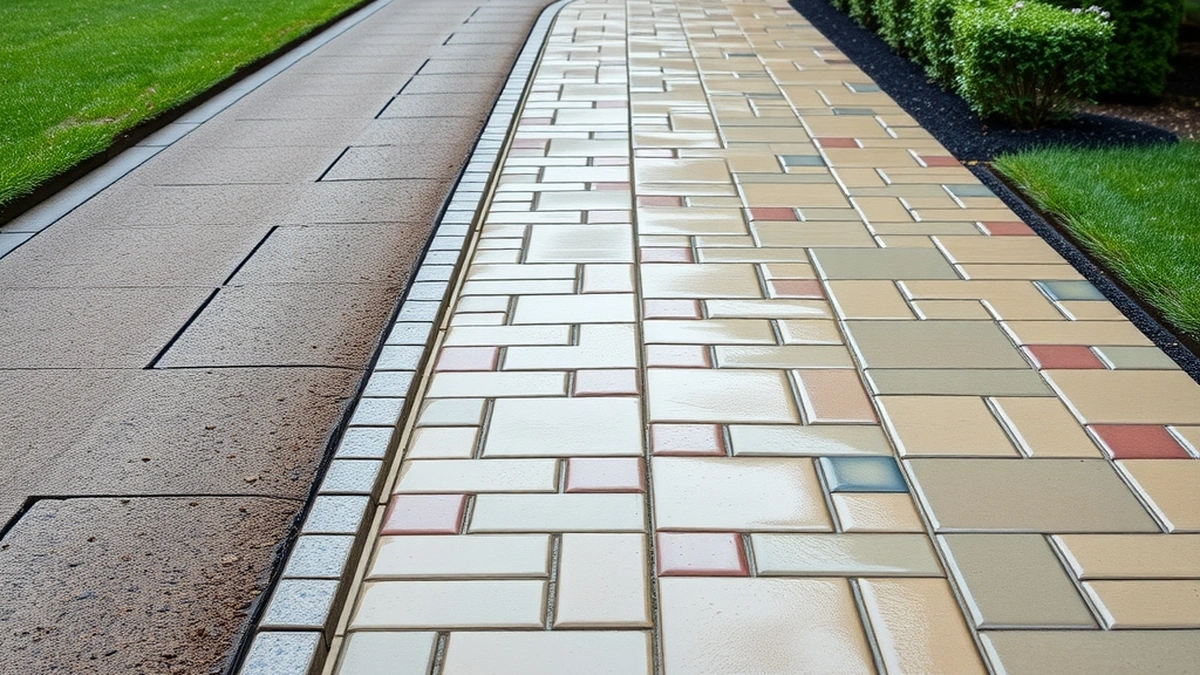
Permeable pavers cost $12 to $25 per square foot installed and concrete pavers $8 to $15. Permeable pays where runoff is regulated or the ground floods; concrete wins on cost and simplicity where drainage works.
- Permeable installed
- $12–$25 per sq ft
- Concrete installed
- $8–$15 per sq ft
- 300 sq ft permeable
- $3,600–$7,500
- 300 sq ft concrete
- $2,400–$4,500
- Base repair, both
- $4–$8 per sq ft
Some links on this page are affiliate links.If you buy through them we may earn a commission at no extra cost to you. We do not accept payment for rankings. Read the full disclosure.
Permeable pavers cost $12 to $25 per square foot installed and concrete pavers cost $8 to $15, so a 300-square-foot driveway is $3,600 to $7,500 or $2,400 to $4,500. The extra money buys stormwater storage, not a better-looking surface. Whether that is worth paying for depends on your soil, your runoff rules, and whether water currently goes where you do not want it.
Cost Compared
| Square feet | Concrete at $8 | Concrete at $15 | Permeable at $12 | Permeable at $25 |
|---|---|---|---|---|
| 150 | $1,200 | $2,250 | $1,800 | $3,750 |
| 300 | $2,400 | $4,500 | $3,600 | $7,500 |
| 500 | $4,000 | $7,500 | $6,000 | $12,500 |
| 800 | $6,400 | $12,000 | $9,600 | $20,000 |
The ranges overlap at the low end of permeable and the high end of concrete, so the decision is rarely settled by price alone. What separates them is what the base is doing. Our permeable paver cost guide and concrete paver cost guide break down the line items.
Two Different Jobs
Concrete pavers are a wearing surface over a compacted base. Their job is to spread load, resist abrasion, and look consistent. Water is expected to run off them.
Permeable pavers are the top of a drainage system. Their job is to admit water into an open-graded reservoir that stores it and releases it into the subsoil or an underdrain. Load carrying is shared with that reservoir.
That difference explains the cost gap. The permeable job includes excavation for a deeper base, washed aggregate instead of dense-graded, and often a perforated underdrain. None of that shows above ground.
Site Requirements
Permeable systems have site conditions that concrete pavers do not care about.
- Subsoil infiltration rate. Slow clay needs a deeper reservoir and usually an underdrain.
- Seasonal high water table. The base must sit above it, or the reservoir never empties.
- Contributing area. Roof and slope runoff add to the load and must be calculated.
- Setbacks. Keep storage away from foundations and utility trenches.
- Local stormwater rules. Some jurisdictions require a plan and an inspection for permeable surfaces.
Concrete pavers need a stable subgrade and a slope away from the building. That is the whole list. If your site fails two or three permeable checks, concrete is not a compromise — it is the correct answer. Correcting a base that was built for the wrong system is the expensive outcome either way: excavation and rebuild runs $4 to $8 per square foot, which is a substantial share of a $12 to $25 installation.
Maintenance Burdens
This is where the comparison turns. Concrete pavers need sweeping, occasional joint sand, and optional sealing at $1 to $3 per square foot.
Permeable pavers need all of that except sealing, which is prohibited, plus two to four vacuum sweeps a year and periodic washed-aggregate top-up. The surface must be tested for infiltration, and clogging has to be caught early.
Neither is high-effort. But permeable maintenance is not optional in the way sealing is optional — a neglected permeable surface degrades into a puddle. Our permeable maintenance guide covers the schedule, and permeable problems covers what happens when it slips.
Longevity and Failure Modes
Both systems last decades on a correct base, and both fail at $4 to $8 per square foot to repair when the base is wrong.
The failure modes differ. Concrete pavers fade, chip at corners, and show efflorescence; repairs are cosmetic and local. Permeable systems clog, and a clogged surface can look perfect while performing badly. Settling under a permeable driveway is more consequential because the base is deeper and the excavation larger.
Concrete pavers are also easier to repair invisibly. A single unit lifts out. On a permeable field, the same unit lifts out, but the joint aggregate around it must be replaced with the correct washed material, not sand.
Where Each One Belongs
Permeable pavers belong on driveways and parking areas where runoff must be managed on site, on sites with a flooding or icing problem, on projects where local rules require infiltration, and on surfaces that will receive regular vacuum maintenance.
Concrete pavers belong on patios, walkways, pool surrounds, and driveways where drainage is already solved by grading and a storm system, and where the owner wants the lowest installed cost with the simplest upkeep.
Most residential projects fall into the second category. That is not an argument against permeable pavers; it is an argument against buying a drainage system for a site that does not need one.
If you want the full technical comparison of the two systems in one place, see concrete pavers versus permeable pavers, and for per-square-foot benchmarking across all paver types, paver patio cost per square foot.
Choosing in Five Checks
- Does water currently pond, flood a garage, or ice over? If yes, price a permeable system first.
- What is the subsoil? Sand drains; clay needs storage depth and an underdrain.
- Do local rules require on-site stormwater management? That can settle it outright.
- Will anyone vacuum sweep two to four times a year? If not, permeable is the wrong product.
- Can the budget absorb $4 to $10 per square foot more? At 500 square feet, that is $2,000 to $5,000.
If the answers point to permeable, read permeable installation before requesting quotes so you can check the base specification. If they point to concrete, concrete paver cost explains what a fair quote contains.
Frequently asked questions
Is permeable paving more expensive than concrete pavers?
Yes, by roughly $4 to $10 per square foot. Permeable runs $12 to $25 installed against $8 to $15 for concrete pavers, because the base is deeper, the aggregate must be washed, and excavation is larger.
Do permeable pavers work as well as concrete pavers?
For carrying loads, yes, when the base is built correctly. Their advantage is stormwater infiltration. Their disadvantage is that the surface and joints must stay open, which adds a maintenance task concrete pavers do not have.
Can I make concrete pavers permeable?
Not by widening joints. A permeable system needs an open-graded base sized for storage, washed bedding, and washed joint fill. Conventional concrete pavers over dense-graded base shed water rather than infiltrate it.
Which is better for a driveway?
Either can work. Concrete pavers at 80 mm over a compacted base are the standard, simple choice. Permeable pavers are the better choice where runoff must be managed on site or where the driveway currently floods.
Do permeable pavers need more maintenance?
Yes. Vacuum sweeping two to four times a year and periodic joint aggregate top-up. Concrete pavers need sweeping, occasional joint sand, and optional sealing, but no infiltration performance to protect.
Will permeable pavers increase my property value?
They can help where local rules reward on-site stormwater management or where a basement or garage floods. The value is site-specific and should not be assumed; the cost difference is $4 to $10 per square foot.
Sources
Some links are affiliate links.If you buy through them we may earn a commission at no extra cost to you. We do not accept payment for rankings. Read the full disclosure.