Clay brick vs Flagstone
Clay brick and flagstone compared on cost, installation labor, joint care and the look each gives a patio, with the base both need.
Clay brick costs $10 to $20 per square foot and flagstone is natural stone priced by the ton. Brick lays fast in uniform units and repairs easily; flagstone is fitted piece by piece, looks more natural, and costs more in labor.
- Clay brick
- $10 - $20 per square foot
- Flagstone
- Priced by the ton
- Install speed
- Brick much faster
- Base repair
- $4 - $8 per square foot
Some links on this page are affiliate links.If you buy through them we may earn a commission at no extra cost to you. We do not accept payment for rankings. Read the full disclosure.
Clay brick and flagstone both make long-lived patios on a compacted base, and both are natural materials. The difference is geometry: brick is modular and fast to lay, flagstone is irregular and fitted by hand. Brick costs $10 to $20 per square foot; flagstone is priced by the ton and usually costs more once labor is included.
What each material is
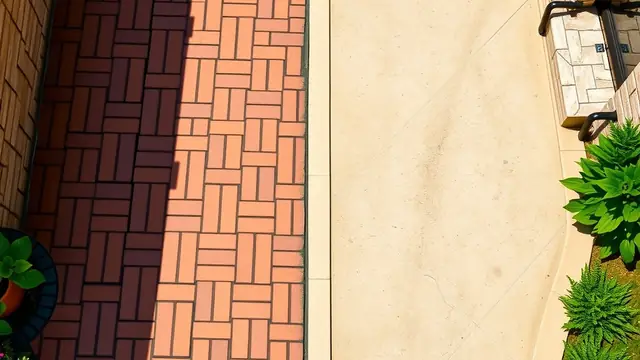
Clay brick is fired clay, formed into rectangular units. The color runs through the body, and the surface has a texture that varies from piece to piece. Because the units are modular, a brick patio can be laid in a running bond, a basket weave or a herringbone without cutting the field.
Flagstone is natural stone, split or sawn to thickness. Pieces vary in shape and size, and each one is fitted to its neighbors.
Both are dry-laid on a sand bed over compacted gravel. The base specification is the same for a patio, and so is the failure mode when the base is thin.
Side by side
| Trait | Clay brick | Flagstone |
|---|---|---|
| Cost | $10 - $20 / sq ft | Priced by the ton |
| Shape | Uniform rectangles | Irregular |
| Install speed | Fast | Slow |
| Cutting | Edges and obstacles | Throughout the field |
| Waste | 5 - 10 percent | 10 - 15 percent |
| Repair match | Good | Difficult |
| Joint width | Narrow | Wide and variable |
| Surface | Textured, uniform | Natural, varied |
The waste row is a real cost. Flagstone is cut throughout the field, and offcuts cannot always be used, so the material order is larger.
The arithmetic on 200 square feet
Clay brick at $15 per square foot: 200 × $15 = $3,000.
Flagstone is priced by the ton. Coverage per ton depends on thickness, so ask for tonnage and expected coverage, then add the fitting labor.
Base repair at $6 per square foot: 200 × $6 = $1,200 for either material. That line is the same for brick and stone, and it is the reason the base should be priced before the surface is chosen.
Sealing at $2 per square foot: 200 × $2 = $400.
Where clay brick wins
Speed is the main advantage. Uniform units lay quickly, and a 200 square foot patio is a short job. The pattern can be set out dry in an afternoon and laid the next day.
Predictable cost is the second. Brick is sold per square foot, so the budget is known before work begins. Flagstone is sold by weight, and the coverage per ton varies with thickness, so the same budget buys a different area depending on the stone.
Repair is the third. A damaged brick is replaced with a matching unit, and the repair blends into the pattern. On a flagstone patio, a replacement stone has to be matched by eye from whatever stock is left.
Where flagstone wins
Appearance is the main reason. No two stones are alike, and the patio reads as stone rather than as a manufactured product. That matters most on a patio that is visible from the house and used as outdoor living space.
Coolness is the second. Stone stays cooler underfoot than brick in direct sun, which matters on a patio used barefoot. The effect is strongest with light-colored stone and weakest with a dark, unshaded surface.
Aging is the third. Flagstone develops a patina, while brick holds a more uniform color over time. On a patio that will be seen for decades, that difference in how the material ages is worth considering.
Joints and what goes in them
Brick joints are narrow and uniform, filled with polymeric sand. The narrow joint is part of what makes a brick patio look tight and orderly. It also takes less fill, which means less material and less washout over a season.
Flagstone joints are wide and variable, filled with polymeric sand or fine gravel. Wide joints take more fill and collect more organic matter.
Both need the joint kept full. An open joint lets water into the bedding and starts the settling process. A wide flagstone joint that has lost its fill is the first place a patio fails.
Installation labor and waste
Brick labor is repetitive and fast. The main skill is keeping the pattern straight and the joints even. A good crew sets a string line and checks it every few courses, and the result looks machine-laid.
Flagstone labor is per piece. Each stone has to be selected, oriented, and sometimes cut to fit. A patio with many small stones takes far longer than one with large slabs. The pattern is also a labor decision: a random layout hides irregularity, while a coursed layout demands more cutting.
That labor difference is the main reason a flagstone quote can be double a brick quote for the same area, even when the stone itself is affordable. It is also why the same flagstone can be cheap on a large-slab patio and expensive on a small-stone one.
Choosing between them
- Set the budget for the finished patio, including base and sealing.
- Decide how much irregularity you want in the pattern.
- Confirm the base depth and the slope for your site.
- Ask for flagstone tonnage and coverage in writing.
- Order 10 to 15 percent extra for flagstone, 5 to 10 for brick.
- Check the joint fill and the maintenance routine for each.
For brick costs, see clay brick cost. For the stone method, read flagstone installation, and for the base both need, check paver base preparation.
Frequently asked questions
Is flagstone more expensive than brick?
Usually yes. Brick runs $10 to $20 per square foot installed, while flagstone is sold by the ton and fitted by hand, which adds labor and waste.
Which is easier to install, brick or flagstone?
Brick. Uniform units and straight edges make layout fast, while flagstone requires cutting and fitting every irregular piece.
Do both need the same base?
Yes, for a patio: about 4 inches of compacted gravel, a 1 inch sand bedding layer, and a 2 percent slope away from the house.
Which is easier to repair?
Brick, because a damaged unit is replaced with a matching one. Flagstone can be reset, but matching stone after the lot changes is difficult.
Does brick need sealing?
Not always. Sealing at $1 to $3 per square foot helps with staining and weed resistance, but many brick patios perform well unsealed.
Which looks more natural?
Flagstone, because it is natural stone with irregular shapes and color variation. Brick is uniform and modular by design.
Sources
Some links are affiliate links.If you buy through them we may earn a commission at no extra cost to you. We do not accept payment for rankings. Read the full disclosure.