Clay brick vs Travertine
Clay brick and travertine compared on cost, weight, heat, staining and freeze-thaw, with the base and sealing each material needs.
Clay brick costs $10 to $20 per square foot and travertine $15 to $30. Brick is lighter, easier to repair and needs less sealing; travertine is cooler underfoot and more dramatic, but it is porous, heavier and needs regular sealing.
- Clay brick
- $10 - $20 per square foot
- Travertine
- $15 - $30 per square foot
- Sealing
- $1 - $3 per square foot
- Base repair
- $4 - $8 per square foot
Some links on this page are affiliate links.If you buy through them we may earn a commission at no extra cost to you. We do not accept payment for rankings. Read the full disclosure.
Clay brick and travertine are both natural materials, and both make handsome patios, but they sit at different price points and demand different maintenance. Brick costs $10 to $20 per square foot, travertine $15 to $30, and the gap buys a cooler surface and a more dramatic look at the cost of sealing and weight.
What each material is
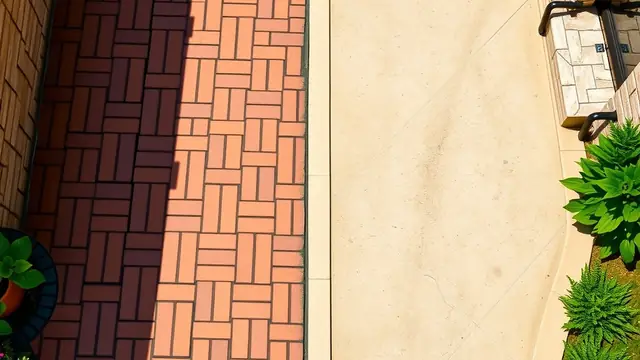
Clay brick is fired clay, formed into modular units. The color runs through the body, and the surface has a natural texture that varies from brick to brick.
Travertine is a natural limestone cut into pavers. It has a banded, fibrous structure and natural voids, and it comes in honed, tumbled and polished finishes.
Both are laid on a compacted base with a sand bedding. Travertine is the heavier of the two, which affects handling and the base specification on a soft subgrade.
Side by side
| Trait | Clay brick | Travertine |
|---|---|---|
| Cost | $10 - $20 / sq ft | $15 - $30 / sq ft |
| Weight | Moderate | Heavy |
| Heat underfoot | Warm to moderate | Cool |
| Porosity | Low to moderate | High |
| Sealing | Optional | Usually required |
| Stain resistance | Good | Low without sealer |
| Repair match | Good | Difficult |
| Freeze-thaw | Grade dependent | Source dependent |
The porosity row explains most of the maintenance difference. Travertine absorbs water and stains, while brick absorbs much less.
The arithmetic on 200 square feet
Clay brick at $15 per square foot: 200 × $15 = $3,000.
Travertine at $22 per square foot: 200 × $22 = $4,400.
Base repair at $6 per square foot applies to both: 200 × $6 = $1,200.
Sealing at $2 per square foot: 200 × $2 = $400. Travertine will need resealing every two to three years; brick may never be sealed.
The material gap is $1,400, and the long-run maintenance gap adds to it.
Where clay brick wins
Cost is the first advantage, and it is consistent across suppliers.
Weight is the second. Brick is lighter than travertine, which makes it easier to handle and less demanding on the base. On a patio with poor access, that difference is a day of labor.
Repair is the third. A damaged brick is replaced with a matching unit, and the color match is easier than with natural stone.
Where travertine wins
Heat is the main advantage. Light travertine stays cool underfoot in direct sun, which is why it dominates pool decks in warm climates. The difference is noticeable on a hot afternoon, especially compared with a dark brick.
Appearance is the second. The banding and color variation give a patio a distinctive look that brick cannot reproduce.
Water behavior is the third. A honed travertine surface sheds water and does not show spots as readily as a dark brick.
Staining, sealing and installation
Brick is relatively dense and resists staining. Oil and grease sit on the surface and clean up with a degreaser. Efflorescence can appear, but it brushes off.
Travertine is porous. Oil, wine, leaf tannins and rust can soak in, and once they do, a poultice may be needed to draw them out. A spill left overnight on unsealed travertine can become a permanent mark.
Sealing at $1 to $3 per square foot is the defense. A penetrating sealer on travertine every two to three years is the maintenance schedule to budget for.
Over a decade, that resealing is two to three applications. On 200 square feet at $2, each application is 200 × $2 = $400, so the ten-year sealing cost is $800 to $1,200. Brick may need one application, or none.
Both materials are laid on a sand bed over compacted gravel, but the handling differs. Travertine is heavier per square foot, so a pallet covers less area and the crew moves more weight for the same patio.
Travertine is also more brittle at the edges. Chipped corners are common during handling, and the chips are visible because the stone is a solid color through the body.
Brick is forgiving. A chipped brick can be turned or placed at an edge, and the color run continues through the unit. That is why brick patios often outlast the crew’s patience for cutting.
Both need cutting at the perimeter and around obstacles. Travertine cuts with a wet saw; brick cuts with a masonry blade or a guillotine.
Freeze-thaw performance
Both materials are available in grades suited to cold climates, and both fail when water is trapped under them. The material grade sets the ceiling; the base and drainage set the floor.
Brick that absorbs water and freezes can spall. Travertine that is saturated and frozen can flake or crack. In both cases, the base drainage matters as much as the material grade.
A patio that drains and a base that does not hold water will outperform a better material on a wet base.
Choosing between them
- Decide how important a cool surface is, which usually means a pool or barefoot use.
- Set the budget including base work and a decade of sealing.
- Confirm the freeze-thaw grade for your climate.
- Choose a honed or tumbled finish if the patio will be wet.
- Ask about replacement availability for the specific product.
- Price the base at $4 to $8 per square foot for either.
For brick costs, see clay brick cost. For the stone side, read travertine pavers cost, and for the base both need, check paver base preparation.
Frequently asked questions
Is travertine better than clay brick for a patio?
It depends on the setting. Travertine is cooler and more dramatic around a pool, while brick is warmer in tone, lighter to handle and cheaper to repair.
Which is cheaper, brick or travertine?
Clay brick at $10 to $20 per square foot is cheaper than travertine at $15 to $30. On a 200 square foot patio at $15 versus $22, the difference is $1,400.
Does travertine need more maintenance than brick?
Yes. Travertine is porous and needs sealing every two to three years, plus pH-neutral cleaners. Brick needs joint sand and occasional weeding.
Which stays cooler in the sun?
Travertine, especially in lighter colors. Brick is cooler than concrete but warmer underfoot than light travertine in direct sun.
Can both be used around a pool?
Yes, with the right finish. Choose a honed or tumbled travertine and a textured brick, and make sure the deck drains away from the coping.
Which is easier to replace if damaged?
Brick, because units are modular and replacement is straightforward. Travertine can be replaced, but matching the stone after the lot changes is difficult.
Sources
Some links are affiliate links.If you buy through them we may earn a commission at no extra cost to you. We do not accept payment for rankings. Read the full disclosure.