Clay brick vs Permeable
Clay brick and permeable pavers compared on cost, drainage, base design and maintenance, including why permeable systems cannot be sealed.
Clay brick costs $10 to $20 per square foot and permeable pavers $12 to $25. Brick is a solid surface that sheds water; permeable pavers pass it through open joints into a storage base. Sealing a permeable system defeats its purpose.
- Clay brick
- $10 - $20 per square foot
- Permeable
- $12 - $25 per square foot
- Sealing
- Brick optional, permeable never
- Base repair
- $4 - $8 per square foot
Some links on this page are affiliate links.If you buy through them we may earn a commission at no extra cost to you. We do not accept payment for rankings. Read the full disclosure.
Clay brick and permeable pavers solve different problems. Brick is a solid surface that sheds water to a drain or a slope; permeable pavers pass water through open joints into a storage base and let it soak away. Brick costs $10 to $20 per square foot, permeable systems $12 to $25, and the difference is mostly in the base.
What each system is
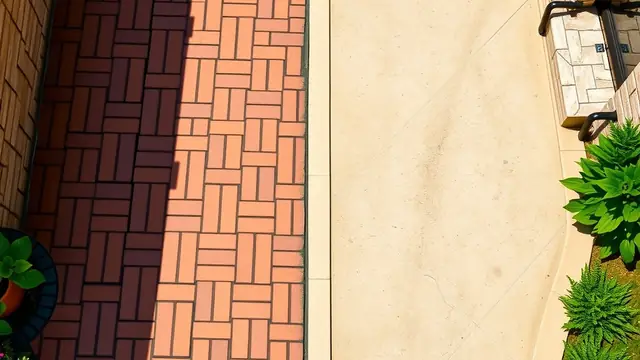
Clay brick is a fired clay unit laid tight with narrow joints. Water runs off the surface to a slope, a drain or a planted edge.
Permeable pavers are units designed with wider joints or openings, laid over an open-graded bedding and a storage base. Water passes through the surface, filters through the bedding, and is held in the storage layer before infiltrating the soil or draining to an outlet.
The surface looks similar from standing height. The base is completely different.
Side by side
| Trait | Clay brick | Permeable pavers |
|---|---|---|
| Cost | $10 - $20 / sq ft | $12 - $25 / sq ft |
| Water handling | Sheds to a drain | Infiltrates on site |
| Base | 4 inches compacted | Storage layer plus bedding |
| Joints | Narrow, filled | Wide, open-graded |
| Sealing | Optional | Never |
| Maintenance | Sweep, weed, seal | Sweep, vacuum, no seal |
| Freeze-thaw | Grade dependent | Design dependent |
| Best use | Patio, walkway | Driveway, patio, parking |
The sealing row is the one that surprises homeowners. A permeable surface is designed to let water through, and a sealer fills the pores and joints that make it work. Sealing a permeable patio is not a maintenance choice; it is a way to break the system.
The arithmetic on 200 square feet
Clay brick at $15 per square foot: 200 × $15 = $3,000.
Permeable pavers at $18 per square foot: 200 × $18 = $3,600.
Base repair, if a system fails, is $4 to $8 per square foot: 200 × $6 = $1,200. On a permeable system, the base is deeper, so a rebuild costs more than the rate suggests.
Sealing brick at $2 per square foot is 200 × $2 = $400. Permeable systems are not sealed, so that line disappears.
Where clay brick wins
Cost is the first advantage, and it applies to both material and base. A standard base is shallower and cheaper than a storage base. On a tight budget, that difference shows up before the first paver is laid.
Familiarity is the second. Any competent paver contractor can lay brick, and the details are well understood. That matters on a small job, where the difference between a good and a poor crew shows up in the joints.
Maintenance is the third. Brick joints can be topped up with sand, and the surface can be swept and washed without special equipment.
Where permeable wins
Stormwater management is the main advantage. A permeable system reduces runoff, which matters on a lot with drainage problems or a local requirement to manage stormwater on site. In some jurisdictions, that requirement is the reason the material is specified at all.
Puddling is the second. A permeable patio does not hold surface water the way a solid surface does, provided the base is designed and maintained.
Tree health is the third. Water infiltrates near the roots rather than running to a drain, which benefits nearby trees.
Base design differences
A permeable base is a storage and filtration system. It typically includes an open-graded gravel storage layer, a geotextile separation layer, and an open-graded bedding course.
The depth depends on the rainfall, the soil infiltration rate, and the area draining to the system. A designer calculates it; it is not a standard 4 inches.
A standard brick base is a compaction and load-spreading layer. Different job, different specification.
That difference is also why a permeable system can fail where a brick patio would not. If the soil beneath does not infiltrate, the storage layer fills and the water has nowhere to go. A test pit and an infiltration rate are the first steps in the design.
Where permeable fails
The most common failure is clogging. Sediment from the surrounding landscape, sand from winter maintenance, and organic matter all fill the joints and the open-graded bedding.
When the surface clogs, water ponds on top of a system designed to pass it, and the patio performs worse than a standard one because the base is holding water.
The second failure is a base designed without an outlet. On clay soil, a storage layer with no overflow becomes a bathtub.
Maintenance keeps it working. The routine is sweeping, periodic vacuuming with a specialized machine, and avoiding sand or soil that washes onto the surface. A permeable patio next to bare soil or a gravel path clogs far faster than one surrounded by established planting.
Brick needs joint sand, occasional weeding and optional sealing. The routines are not interchangeable. A homeowner who wants a low-maintenance surface should weigh the vacuuming against the sealing before choosing.
Choosing between them
- Check whether the site has a stormwater requirement or a drainage problem.
- Confirm the soil infiltration rate before choosing permeable.
- Set the budget with the base included, because the bases differ.
- Decide whether sealing matters, which rules out permeable.
- Confirm the maintenance routine you are willing to do.
- Ask for the base design in writing.
For permeable costs, see permeable pavers cost. For brick, read clay brick cost, and for the base design that decides both, check paver base preparation.
Frequently asked questions
Are permeable pavers more expensive than brick?
Usually. Permeable systems run $12 to $25 per square foot against $10 to $20 for clay brick, because the base includes a storage layer and often a geotextile wrap.
Can clay brick be used as a permeable surface?
Only in a system designed for it, with wide joints and a storage base. Standard brick laid tight is not permeable, and sealing it makes it less so.
Do permeable pavers need sealing?
No, and sealing is counterproductive. The surface relies on open joints and a porous structure, and a sealer clogs both.
How deep is a permeable base?
Deeper than a standard base because it stores water. The depth depends on the rainfall and the soil, and it often includes a gravel storage layer under the bedding.
Which is better in a freeze-thaw climate?
Permeable systems can perform well because water drains rather than pooling, but the base must be designed for frost. Brick is proven in cold climates when it is the right grade.
Can permeable pavers be used on a driveway?
Yes, and that is a common use. The base has to be designed for vehicle loads, which means a deeper storage layer and a suitable subgrade.
Sources
Some links are affiliate links.If you buy through them we may earn a commission at no extra cost to you. We do not accept payment for rankings. Read the full disclosure.