Travertine Installation: Base, Layout, and Setting
Travertine installation: base depth, sand-set versus dry-set, slope, cutting, joints, and sealing, plus the costs and mistakes that decide the result.
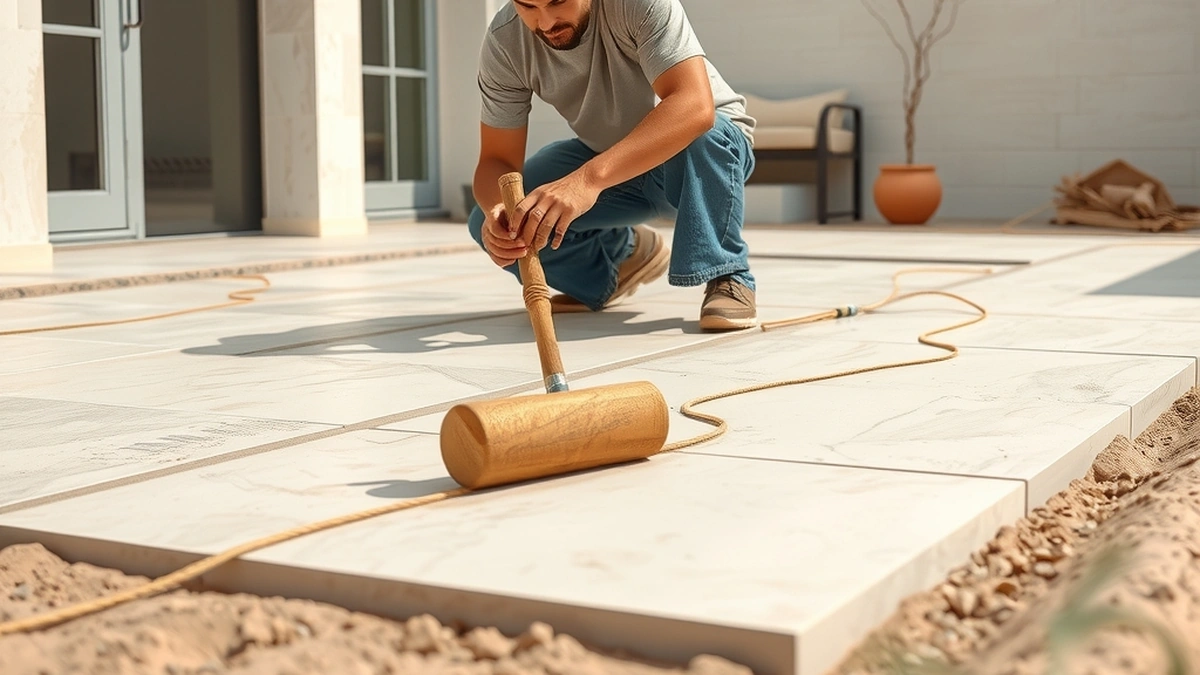
Travertine installation needs a compacted aggregate base, sand or mortar bedding, 1 to 2 percent slope away from the building, and joints of 1/8 to 1/4 inch. Installed cost runs $15 to $30 per square foot.
- Base depth
- 4–6 in compacted
- Minimum slope
- 1–2 percent
- Joint width
- 1/8–1/4 in
- Installed cost
- $15–$30 per sq ft
- Sealing
- $1–$3 per sq ft
Some links on this page are affiliate links.If you buy through them we may earn a commission at no extra cost to you. We do not accept payment for rankings. Read the full disclosure.
Travertine installation succeeds or fails on the base, not the stone. The sequence is a compacted aggregate base, a leveled bedding layer, a slope of 1 to 2 percent away from the building, and stone set with tight, consistent joints. Get those four things right and travertine lasts decades. Skip one and the most expensive stone on the pallet will rock within a season.
What Travertine Installation Involves
Travertine installation is the process of laying sawn natural stone pavers over a prepared base — sand-set over aggregate, or dry-set over a concrete slab — with correct slope, joint width, and edge restraint.
Two properties of the stone shape the method. Travertine is heavy: a 1-1/4 inch paver weighs roughly 17 to 19 pounds per square foot, so a 300-square-foot patio is about 2.5 tons of stone. And it is brittle at the edges, which is why cutting and handling take more care than concrete units do.
The installed cost of $15 to $30 per square foot reflects both. Only part of that is stone. Our travertine cost breakdown separates the lines.
Base Preparation Comes First
Excavate to remove topsoil and any organic material, then proof-roll the subgrade. Soft spots get dug out and replaced, not covered up.
Place four to six inches of aggregate in two-inch lifts, wetting and compacting each lift with a plate compactor or vibratory roller. Density matters more than depth: eight inches of loose aggregate is worse than four inches of properly compacted material.
On a patio, the base surface should already carry the final slope. Trying to build slope into a thin bedding layer produces an uneven field and joints that vary in width across the patio.
Sand-Set Versus Dry-Set Over Concrete
| Aspect | Sand-set over aggregate | Dry-set over concrete |
|---|---|---|
| Base | 4–6 in compacted aggregate plus 1 in bedding sand | Sound concrete slab, cleaned and primed |
| Drainage | Water moves through joints into the base | Water runs off the surface to drains |
| Repair | Lift and reset individual units easily | Mortar bond must be broken to remove a unit |
| Best for | Patios, walkways, pool surrounds | Roof decks, balconies, existing slabs |
| Risk | Base settling if compaction is poor | Slab cracks telegraph through the stone |
Sand-set is the common choice for a ground-level patio. Dry-set is what you use when there is already a structural slab and no room to dig. The two methods are not interchangeable, and a contractor who proposes sand-set over a slab is proposing a bad detail.
Layout, Slope, and Drainage
Set string lines or a laser at the finished elevation before any stone is laid. Slope should fall 1 to 2 percent away from the building — about 1/8 to 1/4 inch per foot — and the fall should be continuous, with no flat spots.
Decide the pattern before the first course. A running bond with a soldier course border is the simplest to lay and the most forgiving. Herringbone and French patterns look better with irregular stone but generate more cuts and more waste, so order 10 percent extra.
Plan the drainage outlet at the same time. Water has to go somewhere: a grade break, a dry well, a channel drain, or a pop-up emitter. A patio that slopes correctly but discharges onto a foundation wall has not solved anything. Our drainage prevention guide covers outlet options.
Cutting and Setting the Field
Score and snap works on thin tile, not on 1-1/4 inch travertine. Use a wet saw with a diamond blade for straight cuts and an angle grinder for notches around posts and steps.
Set each unit onto the screeded bedding, then settle it with a rubber mallet — never a steel hammer. Check every few units against the string line for elevation and against the previous course for joint width. Working in a stair-step pattern keeps the bedding from being walked over and compacted unevenly.
Edge restraint goes in as the field advances, not after. Without it, the perimeter spreads, the joints open, and the whole field loosens from the outside in.
Joints, Cure, and Sealing
Joint width should stay between 1/8 and 1/4 inch. Sweep kiln-dried sand or a stabilized joint sand into the joints and compact lightly. Wider joints on a sand-set patio are acceptable; inconsistent joints are not.
Wait for the stone to dry and for any efflorescence to work its way out before sealing — usually two to four weeks. Then apply a penetrating sealer, not a film-forming one. A film traps moisture, and moisture in travertine in a freeze-thaw climate causes spalling and surface loss. Sealing runs $1 to $3 per square foot.
Keep traffic off a freshly sanded patio for 24 hours and off a sealed one for 48. Our travertine maintenance guide covers the reapplication interval.
Installation Cost at a Glance
| Line | Rate | On a 300 sq ft patio |
|---|---|---|
| Travertine, installed | $15–$30 per sq ft | $4,500–$9,000 |
| Base repair, if needed | $4–$8 per sq ft | $1,200–$2,400 |
| Sealing | $1–$3 per sq ft | $300–$900 |
Those are planning figures. Difficult access, steps, and coping push the top line up; a flat rectangle with truck access pulls it down.
The Installation Sequence in Six Steps
- Excavate and proof-roll the subgrade. Remove organics, find soft spots, and fix them before aggregate goes down.
- Place and compact the base in lifts. Four to six inches, two inches at a time, wetting as you go.
- Set the finished elevation and slope. String lines or laser, 1 to 2 percent fall, continuous.
- Screed the bedding layer. One inch of sand, or mortar over a primed slab for dry-set.
- Lay, cut, and check as you go. String line for elevation, spacer for joint width, rubber mallet only.
- Restrain the edge, fill the joints, and seal after curing. In that order, with the seal last.
For the broader comparison of paver installation methods, see paver patio installation and the installation cost guide. If you are considering doing it yourself, read DIY paver patio first and be honest about the compaction equipment you can rent.
Frequently asked questions
How deep should the base be for travertine pavers?
Four to six inches of compacted open-graded or dense-graded aggregate for a pedestrian patio, compacted in two-inch lifts. Driveways need more, and the subgrade soil has to be stable before any aggregate goes down.
Can travertine be installed over an existing concrete slab?
Yes, with a dry-set or thin-set method using modified mortar, provided the slab is sound, clean, and sloped to drain. Cracked or settled slabs must be repaired first or the travertine will mirror the failure.
What slope does a travertine patio need?
A minimum of 1 percent, and 2 percent is safer, falling away from the building. Standing water is the main cause of staining, efflorescence, and freeze damage on travertine, so the slope is not optional.
Should travertine be sealed before or after installation?
After installation and after the stone has dried, usually a few weeks later. Sealing before grouting can trap moisture under the film and interfere with the joint fill.
How long does travertine installation take?
A 300-square-foot patio is typically two to four days for a crew of two or three, including base work and cutting. Complex patterns, steps, and pool coping add days.
Can I install travertine myself?
A small sand-set patio is within reach for a careful DIYer with a plate compactor and a wet saw. Pool decks, steps, and anything over a slab are better left to crews who do it weekly.
Sources
Some links are affiliate links.If you buy through them we may earn a commission at no extra cost to you. We do not accept payment for rankings. Read the full disclosure.