Travertine maintenance
Travertine maintenance: practical numbers, costs, and trade-offs, written independently.
Travertine maintenance: practical numbers, costs, and trade-offs, written independently. The guide below shows the numbers and the trade-offs.
- Typical range
- Varies by system and site
- First step
- Measure the space and confirm the load
- Professional help
- Recommended for structural or electrical work
Some links on this page are affiliate links.If you buy through them we may earn a commission at no extra cost to you. We do not accept payment for rankings. Read the full disclosure.
Travertine maintenance comes down to three jobs: keep water out of the stone, keep acid off it, and refill the voids that are part of its surface. Sealing at $1 to $3 per sq ft every few years is the only recurring cost that matters, and on a 300 sq ft patio that is $300 to $900 per application. Skip it and the stone stains, pits, and etches in ways that cleaning cannot reverse.
What Travertine Actually Is
Travertine is a sedimentary stone formed by mineral deposits around springs, quarried in blocks, and sawn into pavers. It is calcium carbonate, which means acid attacks it. It is also full of natural voids, which means water and dirt have somewhere to sit. Both properties shape every maintenance decision below.
Sealing: The Cost You Cannot Skip
A penetrating sealer soaks into the pores and slows water absorption without changing the surface appearance. It does not make the stone waterproof, and it does not stop acid etching. It buys time.
At $1 to $3 per sq ft, a 300 sq ft patio costs $300 to $900 per application. Every two to three years is typical for an outdoor deck in a wet climate, longer under a covered porch. Over ten years that is three to four applications, or $900 to $3,600.
Seal when the stone is dry and the forecast is clear for 48 hours. Sealing damp travertine traps moisture and produces a cloudy film that has to be stripped — an expensive way to learn the rule.
Cleaning Without Damaging the Stone
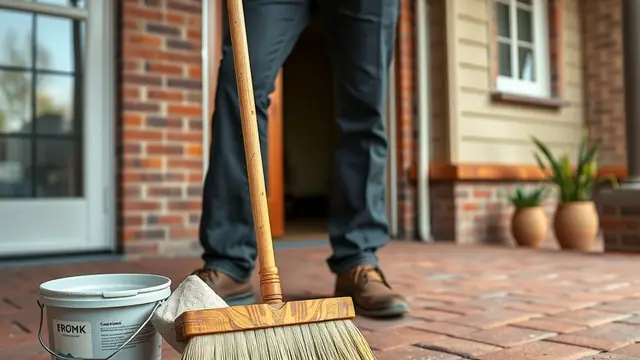
Use pH-neutral cleaner and a soft brush. That is the whole method. Avoid muriatic acid, vinegar, citrus cleaners, and any product labeled “heavy duty” without a stone-safe note, because all of them etch calcium carbonate. A etched travertine paver has a dull, roughened patch that no amount of scrubbing will bring back; the fix is mechanical refinishing, which is a specialist job.
Rinse thoroughly and dry the surface with a squeegee or a blower when the patio is indoors or under cover. Standing water in the voids is what feeds efflorescence and what freezes in a cold snap, and a two-minute dry-down prevents both.
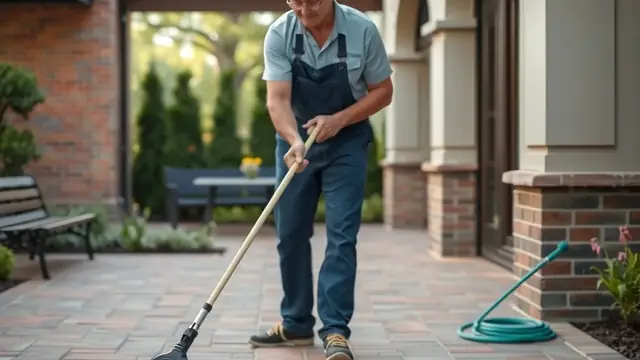
Pressure washing is a risk, not a routine. It can drive water into the voids and strip the joint sand. If a crew proposes it, ask what pressure and what nozzle, and be suspicious of a number over 1,500 psi on stone.
Filling Pits and Holes
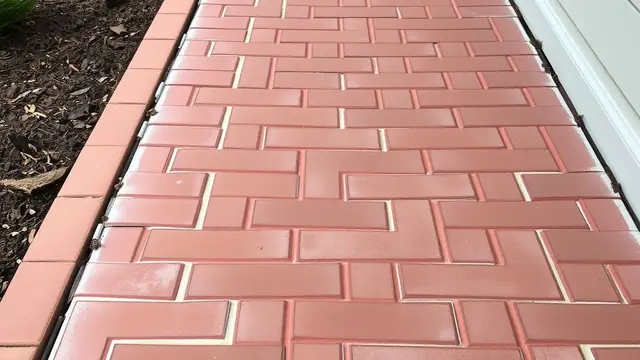
Unfilled travertine keeps its natural pits. They drain better and they look like stone. Filled travertine has those voids grouted smooth, which is more comfortable underfoot and easier to clean, but the filler can work loose over years of freeze-thaw and foot traffic.
Refilling a few voids is a small job: clean the pit, let it dry, press in stone-matching filler, and wipe the surface before it cures. Refilling an entire patio is not a homeowner task, and it is usually the point at which replacement of the worst units makes more sense.
Efflorescence and Acid Stains
Travertine can bloom white like concrete does, and the mechanism is the same: water moving through the assembly, evaporating at the surface, leaving salts behind. Clean it with a stone-safe efflorescence remover, and then find the water. A bloom that returns in the same band every season is a drainage problem under the stone, not a cleaning problem.
Acid stains are different. A spilled drink, a fertilizer spill, or a poorly rinsed cleaner leaves a dull etched ring. Light etching can be polished out by a stone restoration contractor. Deep etching cannot, and the paver gets replaced.
A Maintenance Calendar
| When | Task | Cost |
|---|---|---|
| Spring | Sweep, wash with pH-neutral cleaner, inspect joints | Materials, under $50 |
| Spring | Refill joint sand or aggregate where it has washed out | A bag or two of sand |
| Late spring | Seal if the three-year interval has come around | $1–$3 per sq ft |
| Summer | Spot-clean spills immediately, especially wine and citrus | Near zero |
| Autumn | Clear leaf litter from the surface and joints | Labor only |
| Before winter | Confirm drainage paths are clear; do not seal below 50°F | Inspection |
What Ten Years of Maintenance Costs
On 300 sq ft, with sealing every three years at $1 to $3 per sq ft:
- One application: 300 × $1 = $300 to 300 × $3 = $900
- Three applications in ten years: $900 to $2,700
- Cleaner, brushes, and joint sand over the same period: roughly $150 to $300
- Total: about $1,050 to $3,000
That is $105 to $300 per year on a patio that cost $4,500 to $9,000 to install at $15 to $30 per sq ft. The maintenance is not the expensive part. The expensive part is the repair that follows ten years of skipping it.
The Six-Step Annual Routine
- Sweep the surface and blow out the joints before anything gets wet.
- Wash with a pH-neutral stone cleaner and a soft brush, then rinse thoroughly.
- Inspect the joints and refill any that have dropped below the chamfer.
- Check the low corner and the house line after the first heavy rain of the season.
- Test a small area for water absorption; if water beads, the sealer is still working.
- Seal only when the stone is dry, the temperature is above 50°F, and rain is not forecast for two days.
The routine takes an afternoon and prevents most of the damage that generates repair calls. For the cost side of the same decision, travertine cost covers installation and paver sealing cost covers sealers generally. travertine problems is the failure catalogue, and travertine vs flagstone compares two stones that both demand attention.
Frequently asked questions
What is the most important measurement?
Start with the ceiling or clearance number; it decides which systems can fit.
What does a typical project cost?
Costs vary by system and site access; the guide shows the line items and a planning range.
Can I install this myself?
Some tasks are DIY-friendly, but structural, electrical, and load-bearing work should be done by a licensed professional.
How long does installation take?
A simple setup is a weekend; a full build with electrical or structural work can take several weeks.
What should I check before buying?
Confirm dimensions, load ratings, and the manufacturer's installation requirements for your exact model.
Where can I find local help?
Ask a licensed contractor or installer who has worked with the same system and can inspect your site.
Sources
Some links are affiliate links.If you buy through them we may earn a commission at no extra cost to you. We do not accept payment for rankings. Read the full disclosure.