Concrete Pavers Maintenance: A Year of Care
Concrete pavers maintenance is mostly joint sand, water control, and cleaning. A season-by-season schedule with per-square-foot costs and resealing timing.
Concrete pavers maintenance is mostly joint sand, water control, and cleaning: top up joints once a year, keep water draining away from the surface, and reseal every three to five years at $1 to $3 per square foot. Care typically runs $1 to $4 per square foot per year.
- Joint sand top-up
- $1 - $3 per sq ft
- Reseal interval
- 3 - 5 years
- Sealing cost
- $1 - $3 per sq ft
- Best de-icer
- Sand, not rock salt
- Annual care budget
- $1 - $4 per sq ft
Some links on this page are affiliate links.If you buy through them we may earn a commission at no extra cost to you. We do not accept payment for rankings. Read the full disclosure.
Concrete pavers maintenance comes down to three tasks: keep the joints full, keep water moving away from the surface, and clean before dirt works into the pores. Done on a schedule, it costs $1 to $4 per square foot per year. Skipped, it turns into base repair at $4 to $8 per square foot, which is the number that decides whether a patio is cheap or expensive to own.
What Maintenance Actually Covers
Maintenance is the routine work that preserves a working paver system: refilling joint sand, removing debris and stains, controlling water at downspouts and edges, and reapplying sealer when the old coat wears through.
It is not repair. A settled paver, a failed restraint, or a crack through a unit is a repair job, and no amount of cleaning fixes it. Sorting the two matters because homeowners often spend on cleaning what should be spent on a base fix, and sometimes the reverse.
A Year of Care
| Season | Task | Why it matters |
|---|---|---|
| Spring | Inspect joints, top up sand | Restores interlock before the wet season |
| Spring | Check edges and restraint | Catches spread before rows move |
| Summer | Clean stains, pull weeds | Keeps dirt out of open joints |
| Late summer | Reseal if due | Protects before winter freeze-thaw |
| Fall | Clear leaves, check drainage | Organic matter holds moisture |
| Winter | Use sand, not salt | Limits scaling and edge damage |
The two spring tasks take an afternoon on a 300-square-foot patio. The rest of the year is sweeping and observation.
Joint Sand: The One Task You Cannot Skip
Joint sand is the locking mechanism. It wedges between units, transfers load sideways, and keeps water from running straight into the bedding layer. When it drops, the field loosens and the joints open.
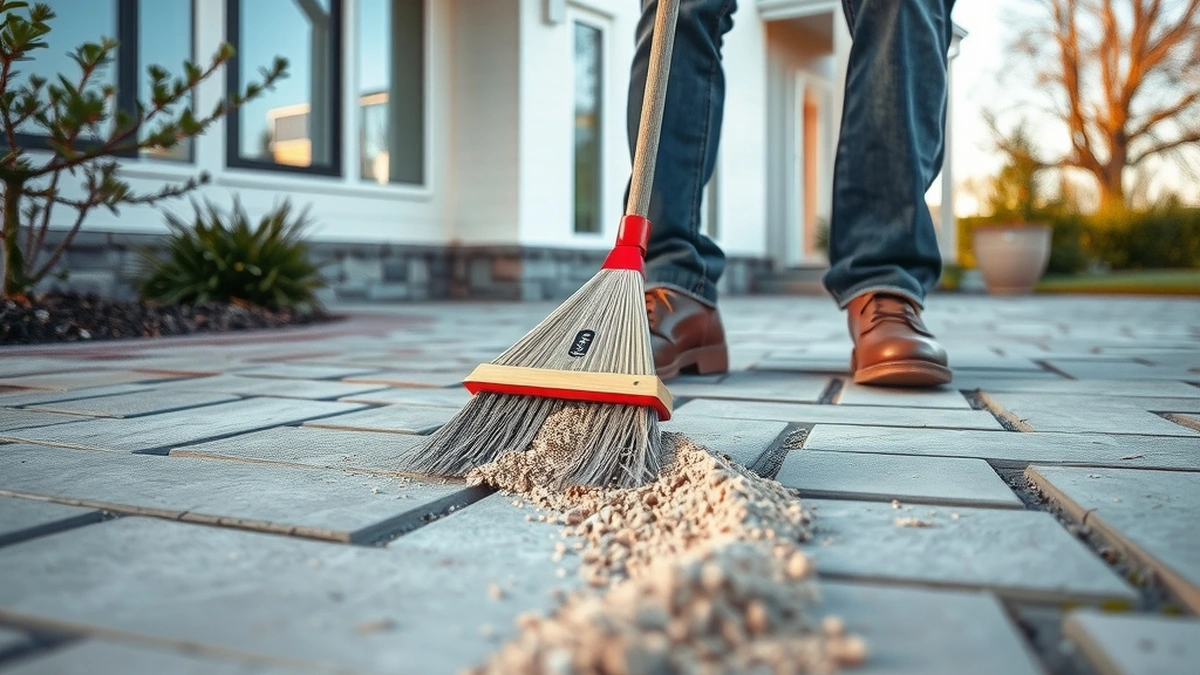
Check joints in spring by pressing a screwdriver into a gap. If the sand sits more than an eighth of an inch below the chamfer, top it up. Sweep dry sand across the surface, work it into the joints with a stiff broom, and compact lightly. Repeat until the joints stay full.
Cost is $1 to $3 per square foot, or $300 to $900 on 300 square feet, and most of that is labor if you hire it. Doing it yourself costs a few bags of sand.
Cleaning Without Damaging the Surface
Concrete pavers tolerate water and mild detergent. They do not tolerate aggressive pressure or acid.
- Sweep or blow off debris before washing, so grit does not scour the surface.
- Use a fan tip on the pressure washer and keep the wand moving. A narrow tip at high pressure strips joint sand and can pit the face.
- Use a pH-neutral cleaner for general dirt. Acid cleaners etch the cement matrix and dull the color.
- For rust and tannin, use a dedicated stain remover and test it on a hidden unit first.
- Rinse thoroughly and let the surface dry before deciding whether it needs sealing.
Pool decks need one addition: rinse splash-out regularly, because pool water leaves mineral deposits as it evaporates.
Sealing on a Cycle, Not a Schedule
Sealer wears. Foot traffic, sun, and cleaning remove it slowly, and the surface tells you when it is due: water stops beading and starts soaking in within a minute or two.
Most patios need resealing every three to five years at $1 to $3 per square foot. On 300 square feet that is $300 to $900 per application, or roughly $60 to $300 per year spread across a five-year cycle.
Two rules prevent most sealing mistakes. Do not seal a new patio in its first season; the units are still drying and efflorescence may not have appeared yet. And never seal over efflorescence, dirt, or a damp surface, because the film traps both moisture and salt. The paver sealing cost guide covers products and timing.
Water Is the Real Maintenance Variable
Nearly every expensive paver problem starts with water. A downspout that discharges onto the patio, a sprinkler head aimed at the surface, a slope that runs toward the house, or a joint that stays wet all winter.
Walk the patio during a heavy rain once a year and watch where the water goes. It should leave the surface within minutes and run away from the foundation. If it ponds for hours, the fall is wrong or the base has settled, and that is a repair conversation rather than a maintenance one. The drainage and pooling guide explains how the fall is checked.
Winter Care and De-Icing
Freeze-thaw cycles are hard on any hard surface. Pavers handle them better than a slab because the field flexes, but the joints and edges still take the damage.
- Clear snow with a plastic-edge shovel. A metal blade catches chips and lifts units.
- Use sand for traction. Rock salt accelerates scaling and attacks the cement matrix at the edges.
- Avoid piling snow against the house, where meltwater can reach the foundation.
- Check the patio in early spring for heaved units before the first mow.
If a unit does heave, it can usually be lifted and reset once the ground thaws. Leaving it through a second winter lets the movement spread.
What Care Costs Over Ten Years
| Item | Rate | On 300 sq ft | Over 10 years |
|---|---|---|---|
| Joint sand, annual | $1 - $3 per sq ft | $300 - $900 | $3,000 - $9,000 if hired yearly |
| Sealing, every 4 years | $1 - $3 per sq ft | $300 - $900 | $600 - $1,800 |
| Spot reset | $2 - $5 per sq ft | $600 - $1,500 | As needed |
| Base repair, if neglected | $4 - $8 per sq ft | $1,200 - $2,400 | Avoidable |
The annual sand figure is the one to scrutinize. Most patios need a full top-up in year one and then only spot refills, so the ten-year total is closer to the sealing figure than to the top of that row. Budget $1 to $4 per square foot per year and you will cover normal care with room for one small repair.
An Annual Checklist
- Walk the surface after rain and note any water that stays more than a few hours.
- Press a screwdriver into joints at four or five points and record the depth.
- Inspect the perimeter for gaps between the outer row and the restraint.
- Pull weeds and refill those joints the same day.
- Rinse the surface, treat stains, and let it dry.
- Test whether water beads. If it soaks in immediately, plan to reseal.
- Check downspouts and sprinklers and redirect anything aimed at the patio.
For the failure modes this schedule prevents, see concrete pavers problems. For the wider patio routine, see paver patio maintenance, and for stain removal, efflorescence.
Frequently asked questions
How often should concrete pavers be sealed?
Every three to five years in most climates, and sooner on a surface that gets heavy sun, pool water, or winter salt. Reseal when water stops beading on the surface.
How often should I add joint sand?
Check joints each spring and top up where they have dropped below the chamfer. New patios usually need a top-up after the first year as the sand settles.
Can I pressure wash concrete pavers?
Yes, with a fan tip and moderate pressure, keeping the wand moving. A narrow high-pressure tip blasts joint sand out and can pit the surface.
Does rock salt damage concrete pavers?
It can. Salt accelerates surface scaling and freeze-thaw damage at the edges. Sand or a calcium chloride alternative is safer on pavers and on nearby concrete.
How do I remove weeds between pavers?
Pull or scrape them, then refill the joint with sand. Weeds grow where sand is missing, so the joint refill is the lasting fix rather than the herbicide.
What is the cheapest way to maintain a paver patio?
Keep joints full, sweep rather than wash, and control the water that runs onto the surface. Sand at $1 to $3 per square foot costs far less than base repair at $4 to $8.
Sources
Some links are affiliate links.If you buy through them we may earn a commission at no extra cost to you. We do not accept payment for rankings. Read the full disclosure.