Best paver patio: what actually matters
Best paver patio: what actually matters: practical numbers, costs, and trade-offs, written independently.
Best paver patio: what actually matters: practical numbers, costs, and trade-offs, written independently. The guide below shows the numbers and the trade-offs.
- Typical range
- Varies by system and site
- First step
- Measure the space and confirm the load
- Professional help
- Recommended for structural or electrical work
Some links on this page are affiliate links.If you buy through them we may earn a commission at no extra cost to you. We do not accept payment for rankings. Read the full disclosure.
There is no single best paver patio. The best patio is the one whose base, unit thickness, and drainage match how you will actually use the surface, and the best-looking paver on the pallet will fail on a base that was never compacted.
What “Best” Means Once the Brochure Is Gone
A paver patio is a surface of factory-made or quarried units laid over a compacted aggregate base and a thin bedding layer, with sand or fine aggregate swept into the joints and a restraint holding the perimeter. Every part of that sentence carries load. The units are the only part you can see, and they are the easiest part to get wrong in a way that stays hidden for two winters.
Reviews rarely help with this. A five-star review of a color tells you nothing about whether the crew compacted the base in 2-inch lifts or dumped 6 inches at once and ran a plate compactor over it for four minutes. The failures that show up in year three are installation failures, and installation is invisible in a photograph.
The Specifications That Decide How It Performs
| Specification | What good looks like | What goes wrong when it is skipped |
|---|---|---|
| Base depth | 4 to 6 in of compacted aggregate for foot traffic | Rutting and rocking within one season |
| Unit thickness | 60 mm for patios, 80 mm wherever a vehicle crosses | Cracked units under a truck or RV |
| Slope | About 1 to 2 percent away from the house | Water against the foundation and in the joints |
| Edge restraint | Spiked aluminum or a concrete curb, set solid | Perimeter creep and opened joints |
| Joint fill | Sand or open-graded aggregate, refilled after compaction | Loss of interlock, weeds, moving edges |
Thickness is not an aesthetic choice. A 60 mm paver is rated for pedestrians; an 80 mm paver is the vehicle-rated unit. No base depth compensates for a paver that was never rated for the load, which is why driveway quotes and patio quotes should not be compared on price alone.
What Each Material Costs Installed
The four common options sit in distinct bands. These are installed rates — units, base, bedding, cutting, and labor — and they are estimates that move with region, access, and pattern.
| Material | Installed rate | 320 sq ft (16 by 20 ft) |
|---|---|---|
| Concrete pavers | $8–$15 per sq ft | $2,560–$4,800 |
| Brick pavers | $10–$20 per sq ft | $3,200–$6,400 |
| Permeable pavers | $12–$25 per sq ft | $3,840–$8,000 |
| Travertine pavers | $15–$30 per sq ft | $4,800–$9,600 |
The arithmetic is simple: 16 ft × 20 ft = 320 sq ft, then 320 × $8 = $2,560 at the bottom of the concrete range and 320 × $15 = $4,800 at the top. Two add-ons belong in the same conversation. Sealing runs $1 to $3 per sq ft, so $320 to $960 on this patio. Base repair runs $4 to $8 per sq ft, or $1,280 to $2,560 if the subgrade has to be rebuilt.
That last number decides whether a project is affordable. Base repair on 320 sq ft can cost more than the pavers, and nobody knows it until someone excavates.
Base and Drainage Beat Every Finish Choice
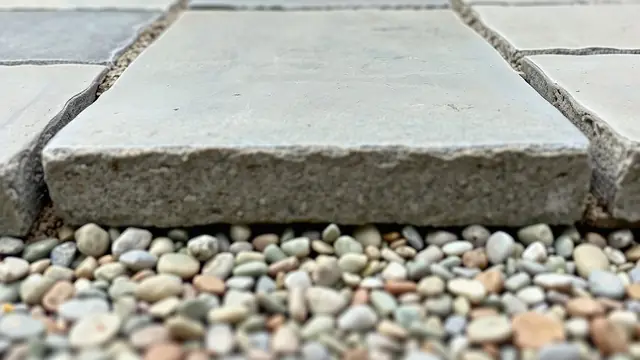
Six inches of base over 320 sq ft is 320 × 0.5 = 160 cubic feet of aggregate, which is 160 ÷ 27 = 5.9 cubic yards before compaction and waste. That material arrives by truck, gets placed in lifts, and gets compacted. It is the part of the job that determines whether the surface is still flat in ten years.
Water is the other half. A patio should shed water away from the house and away from itself. Where the yard falls toward the patio, a surface that is perfectly built will still hold water at its edge, and the fix is grading or a drain rather than another bag of joint sand. paver base preparation walks through the excavation and compaction sequence in detail.
Cheap Patio Versus Properly Built Patio
A cheap patio and a properly built patio often look identical on the day they are finished. They differ underneath, and the difference shows up on a schedule. The cheap version usually has 2 to 3 inches of base, a plastic edge pinned with short spikes, joints filled once, and no compaction after the final sweep. It survives the first winter and starts moving in the second.
The properly built version has base depth written on the quote, compaction described in lifts, a restraint set solid on the perimeter, and joint sand refilled after the last pass. It costs more per square foot in year one and less per year of service, because resetting a settled corner at $4 to $8 per sq ft is how the savings get spent.
Matching the Surface to the Use
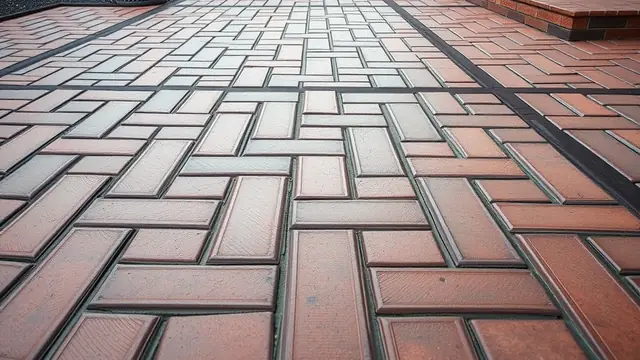
A pool deck wants a unit that stays cool and grippy when wet, which usually means a lighter color and a tumbled or shot-blasted finish rather than a polished one. A driveway wants 80 mm units and a base sized for vehicle loads. A walkway can use 60 mm units in a running bond and still last decades, because foot traffic is gentle and the area is small enough that a repair stays cheap.
The paver type matters less than the finish and the thickness. That is the argument in types of paver patio, which sorts the options by use rather than by price.
How to Vet a Quote in Five Steps
- Ask for the square footage, the unit thickness in millimeters, and the base depth in inches, all in writing.
- Ask how the base will be compacted — lift thickness and equipment — and whether compaction happens before and after the bedding layer.
- Confirm the edge restraint type and whether it is set in concrete.
- Confirm 5 to 10 percent waste is included in the material line rather than billed later.
- Price sealing and any drainage work as separate lines so you can decide after the base is opened.
One quote that answers none of those five is a number, not a bid.
A Realistic Way to Choose
Start with the use, then the thickness, then the base, then the material you can afford at that specification. On a 320 sq ft patio that order produces a concrete paver job at $2,560 to $4,800 with a base you can trust, which is a better patio than a travertine job at $9,600 on three inches of gravel. Budget sealing separately at $320 to $960, and keep $1,280 to $2,560 in reserve in case the base is worse than the surface suggested.
For the project math, see paver patio cost and paver patio cost per square foot. For the build sequence itself, paver patio installation is the long version. If you are still weighing materials, paver patio versus concrete is the honest comparison.
Frequently asked questions
What is the most important measurement?
Start with the ceiling or clearance number; it decides which systems can fit.
What does a typical project cost?
Costs vary by system and site access; the guide shows the line items and a planning range.
Can I install this myself?
Some tasks are DIY-friendly, but structural, electrical, and load-bearing work should be done by a licensed professional.
How long does installation take?
A simple setup is a weekend; a full build with electrical or structural work can take several weeks.
What should I check before buying?
Confirm dimensions, load ratings, and the manufacturer's installation requirements for your exact model.
Where can I find local help?
Ask a licensed contractor or installer who has worked with the same system and can inspect your site.
Sources
Some links are affiliate links.If you buy through them we may earn a commission at no extra cost to you. We do not accept payment for rankings. Read the full disclosure.