Paver Patio vs Concrete Patio: Cost, Life, Repairs
Compare paver and concrete patios on installed cost, lifespan, drainage, and repair. Includes per-square-foot arithmetic for a 400 sq ft patio.
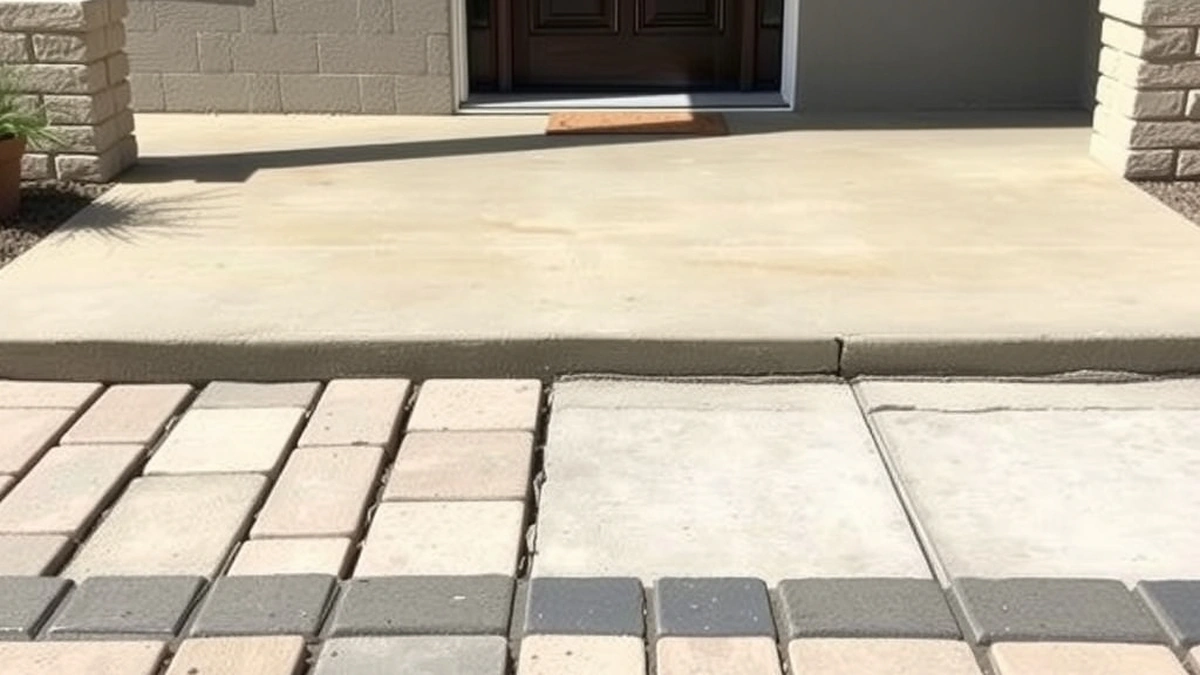
Pavers cost $8 to $30 per square foot installed and can be repaired one unit at a time. A plain concrete slab runs roughly $6 to $12 per square foot, is cheaper up front, and is expensive to replace once it cracks.
- Paver patio installed
- $8–$30 per sq ft
- Plain concrete slab (estimate)
- $6–$12 per sq ft
- 400 sq ft paver patio
- $3,200–$12,000
- Paver service life
- 20–30 years
Some links on this page are affiliate links.If you buy through them we may earn a commission at no extra cost to you. We do not accept payment for rankings. Read the full disclosure.
A paver patio and a poured concrete patio do the same job with different economics. Pavers cost more up front — $8 to $30 per square foot installed — but individual units can be lifted and reset, while a concrete slab is cheaper to place and much harder to repair once it cracks. The right choice comes down to how long you plan to stay, how the ground moves under the surface, and whether you can absorb the difference now to avoid a bigger bill later.
What Each Surface Actually Is
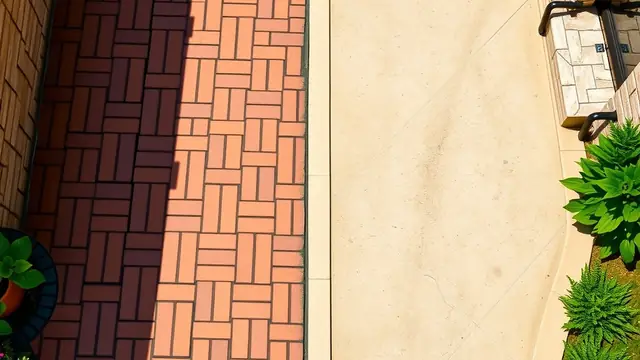
A paver patio is a compacted aggregate base covered by a one-inch sand setting bed and individual paving units held in place by edge restraints and swept joint sand. The surface is segmented by design, so minor ground movement shows up as a slightly uneven joint rather than a crack running across the field.
A poured concrete patio is a single slab, usually 4 inches thick for foot traffic, reinforced with welded wire mesh or synthetic fiber and cut with control joints within a day of finishing. Those joints are engineered weak points that persuade the slab to crack in a straight line instead of randomly. There is no setting bed and no individual unit to replace.
Cost Comparison
Both surfaces need excavation and compacted gravel, so the base is not where the price gap comes from. Pavers add a sand bed, edge restraint, joint sand, and far more hand labor.
| Measure | Paver patio | Poured concrete patio |
|---|---|---|
| Installed cost per sq ft | $8–$30 | about $6–$12 plain slab (estimate) |
| 400 sq ft total | $3,200–$12,000 | $2,400–$4,800 (estimate) |
| Base build | 4–6 in compacted gravel plus 1 in sand | 4 in compacted gravel |
| Typical repair | lift and reset individual units | cut out and patch, or overlay |
| Joint upkeep | top up joint sand, optional seal | reseal or caulk control joints |
| Realistic service life | 20–30 years | 25–30 years, hairline cracks likely |
Run the arithmetic on a 400-square-foot patio. At the bottom of the paver range, 400 × $8 = $3,200. At the top, 400 × $30 = $12,000. Break it down by material and the spread narrows: concrete pavers at $8 to $15 per square foot produce $3,200 to $6,000, brick pavers at $10 to $20 produce $4,000 to $8,000, and travertine at $15 to $30 produces $6,000 to $12,000.
The concrete figure is a planning estimate for a broom-finished slab in a mid-cost US market, not a quote. Stamped, colored, or exposed-aggregate finishes push a slab into paver territory, which is why the two options often end up within a few hundred dollars of each other on small jobs.
Lifespan and Repair
A paver patio over a properly compacted base typically lasts 20 to 30 years, and longer if the base stays dry. Cracked or stained units can be swapped one at a time, which is why pavers are common around pools, under downspouts, and anywhere a drain line might later cut through the surface. Budget $4 to $8 per square foot for base repair if the subgrade turns out to be soft or an old patio has to come out.
Concrete slabs of the same age tend to develop hairline shrinkage cracks that are cosmetic, plus the occasional structural crack from settlement or tree roots. Filling a cosmetic crack is inexpensive. A slab that has settled on one side usually means mudjacking or replacing an entire section, and a patch never matches the original color exactly.
Water, Frost, and Movement
Pavers move water through the joints, so the base and the slope matter more than the surface material. A patio should fall away from the house at roughly 1/8 inch per foot — about 1 inch over 8 feet — and discharge to a splash block, lawn, or drain. Pooling against the foundation is the most common paver complaint, and it is a grading problem rather than a paver problem.
Concrete sheds water off the top into whatever slope the finisher left. Freeze-thaw cycles are harder on slabs because water sits in control joints and hairline cracks, then expands. Pavers handle frost better in the sense that heave is distributed across many small joints, but they still need a draining base and an edge restraint that holds the perimeter. Permeable pavers go further, storing and infiltrating runoff through open joints and an open-graded base at $12 to $25 per square foot.
Where Concrete Still Wins
Concrete is the better answer when the budget is fixed and low, when the patio is small and simple, when the surface will sit under a roof and rarely see freeze-thaw, or when you want a seamless modern look that pavers cannot reproduce. It is also faster: a slab can be placed and finished in a day, while a paver patio of the same size is usually a two- to four-day job including base compaction.
Pavers win when the ground is suspect, when the patio has to match a driveway or walkway, when you plan to stay long enough to amortize the cost, and when repairability matters more than the lowest bid.
What to Do Next
- Measure the actual area in square feet, including any border course you want.
- Look at what sits under the proposed patio. Sandy soil drains, clay holds water, and fill dirt compacts unpredictably.
- Get three written quotes that itemize excavation, base depth, and compaction instead of a single per-square-foot number.
- Ask each contractor how water leaves the patio and where it goes.
- Add $1 to $3 per square foot if you want sealing, and ask whether the quote includes a first-year re-sand.
- Compare 20-year cost rather than bid price. One slab replacement usually erases the concrete savings.
The Practical Verdict
For a patio you intend to keep, pavers are the more serviceable surface, and most of the premium is labor you pay for once. For a tight budget and a simple, sheltered slab, concrete is honest value. Either way the base and the slope decide whether the patio lasts; the surface only decides how it looks while it does.
Our paver patio cost guide breaks the budget down by size, and paver patio installation covers the build sequence in detail. If you already have a surface that has moved, start with paver patio repair and drainage and pooling prevention.
Frequently asked questions
Is a paver patio worth the extra cost over concrete?
It is when you plan to stay in the house and the ground moves. Individual pavers can be lifted and reset for a fraction of the cost of cutting out and replacing a settled slab section.
Which surface handles freeze-thaw better?
Pavers usually fare better because movement is spread across many small joints instead of concentrating in a few cracks. Both still depend on a compacted, draining base and correct slope away from the house.
Can pavers be laid over an existing concrete slab?
Sometimes, if the slab is sound, flat, and drains properly. A bonded overlay or a sand-set layer with edge restraint can work, but any cracked or settled slab has to be repaired first.
How much does it cost to fix a settled paver patio?
Base repair runs $4 to $8 per square foot when the aggregate under the surface has to be removed, recompacted, or replaced. Lifting and resetting units without base work is cheaper.
Does a concrete patio add resale value?
Both surfaces add usable outdoor space that buyers count. Pavers tend to photograph better and read as a premium finish, while a plain slab reads as basic hardscape.
How long before a paver patio needs re-sanding?
Joint sand typically needs topping up every one to three years, depending on rain, slope, and foot traffic. Sealing at $1 to $3 per square foot slows the loss.
Sources
Some links are affiliate links.If you buy through them we may earn a commission at no extra cost to you. We do not accept payment for rankings. Read the full disclosure.