Paver vs Concrete: Cost, Drainage, and Repairs
Pavers cost $8 to $15 per square foot installed and poured concrete $6 to $12. Compare construction, drainage, repairs, and 20-year cost with real arithmetic.
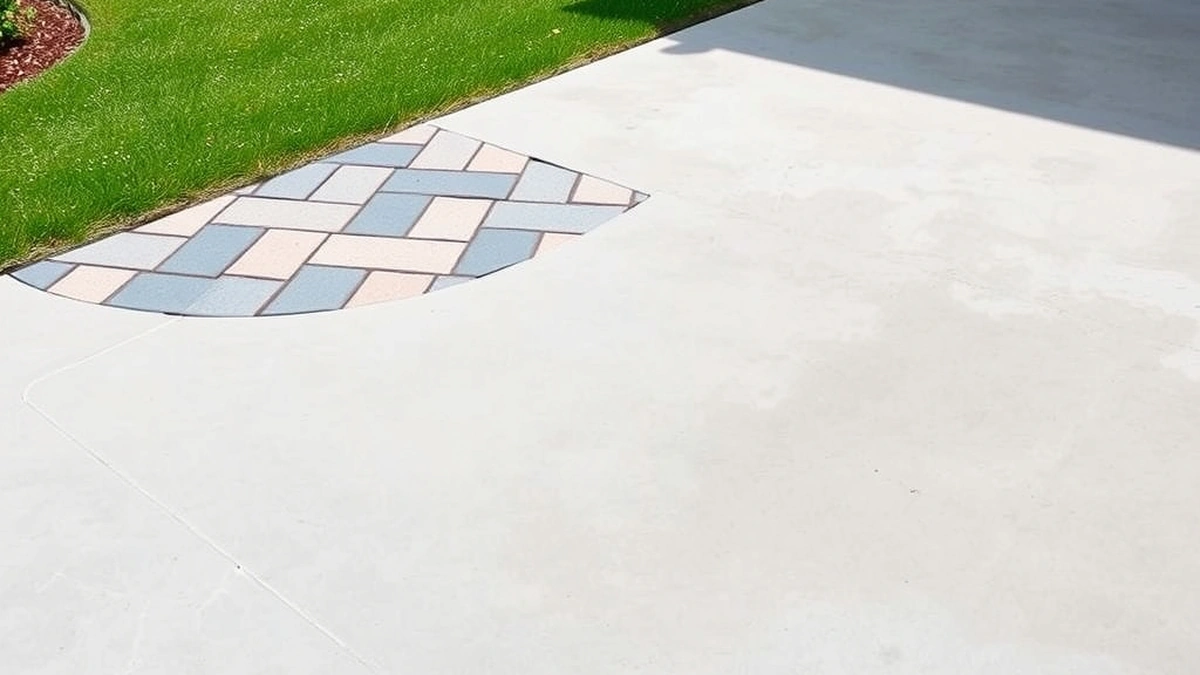
Concrete pavers cost $8 to $15 per square foot installed against roughly $6 to $12 for a poured slab. The slab is cheaper up front. Pavers cost more initially but lift and reset one unit at a time, while a cracked slab usually means a patch or a full replacement.
- Concrete pavers installed
- $8 - $15 per sq ft
- Poured slab installed
- $6 - $12 per sq ft
- Base under pavers
- 4 - 6 in compacted aggregate
- Joint width
- 1/8 - 1/4 in
- Sealing, optional
- $1 - $3 per sq ft
Some links on this page are affiliate links.If you buy through them we may earn a commission at no extra cost to you. We do not accept payment for rankings. Read the full disclosure.
Concrete pavers cost $8 to $15 per square foot installed, and a poured concrete slab runs roughly $6 to $12. The slab wins on day one by $800 to $1,200 on a 400-square-foot patio. Pavers win later, because a failed unit is a one-hour repair and a failed slab is usually a demolition.
Two Different Ways to Build a Surface
Concrete pavers are individual units laid on a compacted aggregate base and bedding sand, with sand in the joints and an edge restraint holding the field tight. The surface is flexible: each unit carries load, and the joints absorb small movements.
A concrete slab is a continuous plate, usually 4 inches thick for pedestrian use, poured over a prepared subgrade and often reinforced with mesh. It carries load in one piece and cracks when it cannot.
That single difference explains almost every cost, drainage, and repair question that follows. A flexible surface distributes movement across thousands of joints. A rigid surface concentrates it into a crack.
Cost per Square Foot, Side by Side
| Area | Pavers at $8 | Pavers at $15 | Slab at $6 | Slab at $12 |
|---|---|---|---|---|
| 200 sq ft | $1,600 | $3,000 | $1,200 | $2,400 |
| 400 sq ft | $3,200 | $6,000 | $2,400 | $4,800 |
| 600 sq ft | $4,800 | $9,000 | $3,600 | $7,200 |
The arithmetic is area × rate. On 400 square feet the gap is 400 × $8 = $3,200 against 400 × $6 = $2,400 at the low end, and 400 × $15 = $6,000 against 400 × $12 = $4,800 at the high end. The difference is $800 to $1,200, or about $2 to $3 per square foot.
What the slab price does not include is the finish. Broom-finished concrete is the cheapest version. Stamped, colored, or exposed-aggregate slabs add cost per square foot and often land in paver territory, which is why the two surfaces are compared at all.
Where the Paver Money Goes
A paver quote breaks into four visible parts:
- Excavation and disposal of the old surface, where one exists
- Four to six inches of compacted aggregate base, placed in lifts
- One inch of bedding sand, screeded to grade
- Units, edge restraint, joint sand, cutting, and labor
The base is the part homeowners underestimate. It is also the part that decides whether the surface stays flat. A paver patio on a shallow, poorly compacted base fails the same way a slab on a bad subgrade does. The paver base preparation guide covers depth and compaction in detail.
Drainage: Joints Versus Slope
Pavers drain two ways. Water runs off the surface on the slope the installer builds, typically a fall of about 1 inch per 4 feet away from the house, and a small amount infiltrates the joints and bedding before moving through the base.
A slab drains one way: across the surface to a low point or a drain. That works until the slab settles or a control joint opens. Water that reaches the subgrade under a slab has nowhere to leave, and in a freeze-thaw climate it expands there.
Neither surface tolerates a slope toward the house. If the grade is wrong, pavers can be lifted and re-screeded in a section. A slab has to be mudjacked or replaced. Our drainage and pooling guide covers how the fall is checked before a patio is built.
Repairs: Unit Work Versus Slab Work
| Failure | Paver response | Slab response |
|---|---|---|
| Local settlement | Lift, re-level base, reset units | Mudjack or patch, or replace |
| Single crack | Not applicable | Route and fill, monitor |
| Broken surface unit | Replace one paver | Patch visible, color rarely matches |
| Tree root heave | Lift and re-lay the affected run | Cut root, slab may crack again |
| Utility repair | Lift and re-lay the same units | Cut, dig, pour a patch |
Paver repair is priced at roughly $2 to $5 per square foot for resetting and joint sand, plus $4 to $8 per square foot where the base has failed. On a 40-square-foot section that is $80 to $200 for the surface work, or $240 to $520 with base repair included. A 400-square-foot slab replacement at $6 to $12 per square foot is $2,400 to $4,800.
That asymmetry is the whole financial argument for pavers. The paver repair cost guide shows the same arithmetic at more repair scopes.
Where Concrete Wins
Concrete is the right answer in four situations.
- Budget is the binding constraint. At $6 to $12 per square foot it is the cheapest hard surface, and a broom finish is serviceable.
- The area is small and simple. A 10-foot by 10-foot pad with no curves and no drainage complications is quick to pour.
- The surface is structural. Shed floors, equipment pads, and garage aprons want a slab, not pavers.
- Nothing heavy will cross it and nothing will shift under it. On stable soil with no trees, a slab can sit for decades without a problem.
The counterargument is the one thing a slab cannot do: give back a single square foot. Once a slab cracks through, patching is cosmetic and the crack returns. Pavers are designed to be taken apart.
What to Check in Either Quote
- Ask for the base specification in writing: depth, aggregate type, and compaction method.
- Confirm the slope and where water leaves the surface.
- Ask what thickness is specified. Pavers should be 60 mm for foot traffic and 80 mm for vehicles.
- Confirm edge restraint. Pavers without it spread at the perimeter.
- For a slab, ask the thickness, whether mesh is included, and where the control joints will be cut.
- Ask for the disposal line separately. Hauling away an old surface is often the difference between two quotes.
If you want the patio-specific version of this comparison, including lifespan expectations and resale, see paver patio versus concrete patio. For the installed paver rate in more detail, see concrete pavers cost.
The Decision in Practice
Choose concrete when the area is simple, the soil is stable, the budget is tight, and you accept that a structural crack means replacement. Choose pavers when the surface has to be repairable, when the grade is complicated, when frost or tree roots are present, or when the patio will be lifted for utilities or drainage work at some point.
The up-front difference is $2 to $3 per square foot on a typical patio. Over twenty years, one slab replacement costs more than that difference, and one paver reset costs less than either.
Frequently asked questions
Is paver cheaper than concrete?
No, not at installation. Pavers run $8 to $15 per square foot and a plain slab $6 to $12. Pavers close the gap over time because individual units can be reset instead of replacing the whole surface.
How much more does a paver patio cost than concrete?
On 400 square feet, pavers are $3,200 to $6,000 and a slab $2,400 to $4,800, a difference of $800 to $1,200 at the ends of each range.
Why do pavers handle freeze-thaw better than a slab?
Pavers move independently on a flexible base, so frost heave lifts units rather than cracking one continuous surface. The joints also give water somewhere to go.
Can you pour concrete over an old paver patio?
No. The base is designed to flex and drain, and a slab needs a stable, uniform subgrade. The pavers have to come out before a slab can be placed.
Do pavers need a concrete base?
Not for pedestrian use. Patios and walkways sit on compacted aggregate and bedding sand. Driveways use the same principle with a deeper base and thicker units.
Which surface lasts longer?
A well-built paver patio can last decades and be repaired in sections. A slab lasts decades too, but once structural cracks appear the repair options are limited.
Sources
Some links are affiliate links.If you buy through them we may earn a commission at no extra cost to you. We do not accept payment for rankings. Read the full disclosure.