Drainage Pooling: Warning Signs
Learn how to spot drainage pooling issues early and fix them before they damage your paver patio or driveway.
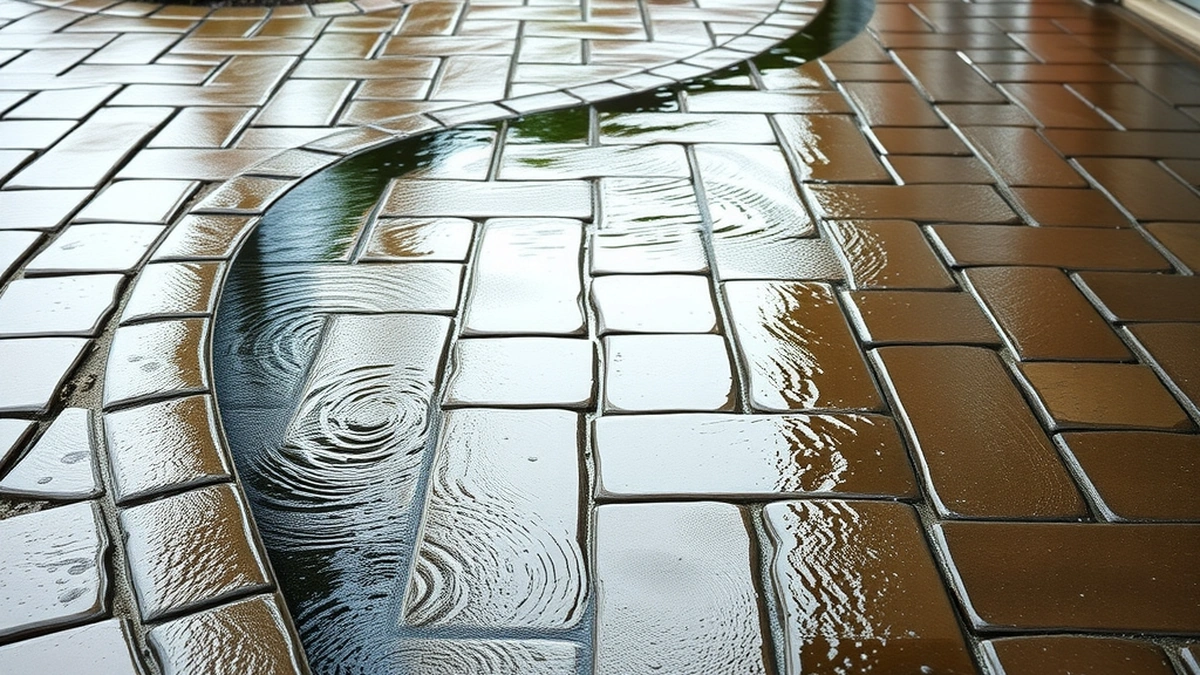
Drainage pooling often appears as water stains, edge erosion, or cracked pavers. If water sits in the joints after rain, it is time to inspect your base and add drainage solutions.
- Typical range
- Varies by system and site
- First step
- Measure the space and confirm the load
- Professional help
- Recommended for structural or electrical work
Some links on this page are affiliate links.If you buy through them we may earn a commission at no extra cost to you. We do not accept payment for rankings. Read the full disclosure.
Water that is still standing on a paver patio the morning after a storm is the sign that matters. Pooling is rarely a surface problem, and it is almost never solved by adding joint sand. It usually means the slope is wrong, the base has settled, or the joints and base have stopped accepting water, and each of those has a different price attached.
What Pooling Actually Looks Like
Pooling is water standing on the surface or held in the joints longer than the assembly was designed to drain. A properly built patio sheds most of a storm within minutes and holds nothing in the field. A little water in a birdbath-low corner during heavy rain is normal. Water still there the next day is not.
The signs arrive in a rough order, and reading them in that order saves money.
| Sign | What it usually means | Urgency |
|---|---|---|
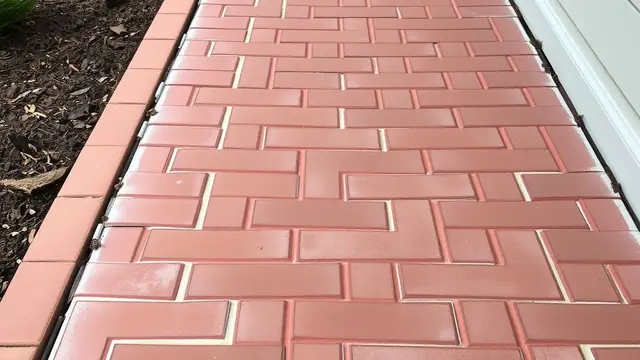
| Dark joint lines hours after rain | Joint sand has washed out or compacted | Low — refill and compact |
| Water in one shallow dish | Local settlement in the base | Moderate — spot repair |
| Sand collecting at the patio edge | Joint sand migrating with runoff | Moderate — check restraint |
| White salt bloom at the low point | Moisture wicking and evaporating there | Moderate — find the water source |
| Pavers rocking at the wet area | Base has lost support under those units | High — rebuild that section |
| Water against the house or sill | Slope runs the wrong way | High — regrade or drain |
Why Water Sits: Slope, Base, and Joints
Three failures account for most of it. The first is slope. A patio needs roughly 1 to 2 percent fall away from the house, which is about 1/8 inch per foot. A surface that is dead flat, or that tips back toward the wall, ponds by design.
The second is the base. Aggregate placed too thin, or placed and never compacted in lifts, consolidates under traffic and creates the low dish where water collects. Once a dish forms, water sits in it, the joint sand washes out, and the pavers over it begin to rock.
The third is the joint and the surface. Joint sand that has washed away leaves gaps that accept water quickly at first and then hold it. On a permeable system the equivalent failure is clogging: fines fill the open joints and the reservoir stops receiving water at the rate it was sized for.
What a Fix Costs
Base repair is the line item that sets the budget, at $4 to $8 per sq ft. On a 120 sq ft wet corner that is 120 × $4 = $480 to 120 × $8 = $960. On a 300 sq ft patio where the whole field has settled, it is 300 × $4 = $1,200 to 300 × $8 = $2,400.
Add the surface work. If the pavers come up and go back down, that is labor and joint sand rather than new units. If units are cracked or the color is discontinued, replacement units at an installed rate of $8 to $15 per sq ft apply only to the replaced area — 40 sq ft at $8 to $15 is $320 to $600.
Sealing after the repair runs $1 to $3 per sq ft, so $120 to $360 on 120 sq ft and $300 to $900 on 300 sq ft. It is optional, and it should wait until the repaired area has dried and any efflorescence has finished.
Surface Fix Versus Base Fix
A surface fix is sweeping sand into the joints, recompacting the field, and resetting two or three rocked units. It costs a few hundred dollars on a small area and it buys time. It does not change the slope and it does not restore a failed base, so the water returns to the same low spot at the next heavy rain.
A base fix is excavation: remove the units, take out the failed aggregate, re-grade, place and compact new base in lifts, re-bed, and relay. It costs $4 to $8 per sq ft and it is the only version that removes the dish. The judgment call is how much of the patio has the problem. One corner is a spot repair. A wet band across the middle, or water against the house, is a base fix.
How to Inspect After a Rain
- Photograph the surface 30 minutes after the rain stops, so you can see where water is still sheeting.
- Check again the next morning and mark every area still holding water with chalk.
- Probe the wet spots with a screwdriver; soft or spongy base shows up as easy penetration beside a paver.
- Look at the house line and confirm the surface falls away from the wall.
- Check the patio edge for washed sand, spread restraint, or soil erosion that shows where the water is leaving.
Those five observations tell a contractor more than a description over the phone, and they stop the conversation from starting at full replacement.
When to Call Someone
Call when water reaches the house, when a section of pavers rocks underfoot, or when the same low spot returns within a season of being repaired. Those three point at base or grade, and both are beyond a homeowner’s weekend fix. A single soft spot in a corner with no structural movement can wait for spring, and watching it through one wet season costs nothing.
The other trigger is money. If a quote proposes a full rebuild for a 300 sq ft patio, compare it against the spot-repair arithmetic first: 40 sq ft of repair at $4 to $8 per sq ft for the base plus $8 to $15 per sq ft for replacement units is $320 to $920, against $1,200 to $2,400 for the whole field. Ask the contractor to point at the failed area on the surface and explain why the rest of the base has to come out. Sometimes the answer is convincing. Sometimes it is a sales script.
For the repair sequence, drainage pooling prevention covers grading and drains, and paver patio repair covers the excavation and reset. If the base has to be rebuilt, paver base preparation is the specification to hand a contractor. For what the work should cost before you call, see settling cost and paver repair cost.
Frequently asked questions
What causes drainage pooling on paver patios?
Poorly compacted bases, inadequate slope, or clogged joints allow water to collect instead of flowing away.
How can I tell if my paver patio has drainage issues?
Look for water stains in the joints, edges lifting, or soft spots underfoot after rain.
Does drainage pooling cause paver cracks?
Yes, standing water erodes the sand joint material and applies hydrostatic pressure that pushes pavers apart.
How much does base repair cost per square foot?
Base repair typically costs $4 to $8 per square foot depending on how much material needs replacing.
Should I replace permeable pavers if water pools?
Permeable pavers ($12-$25/sq ft) allow water infiltration, but you still need proper grading and base preparation.
When should I hire a professional for drainage?
If pooling persists for several days after rain or you see structural damage, consult a paver specialist.
Sources
Some links are affiliate links.If you buy through them we may earn a commission at no extra cost to you. We do not accept payment for rankings. Read the full disclosure.