Paver Patio and Walkway Layout Guide
Plan and lay out a paver patio and walkway with proper base prep, slope, edge restraints, and joint sand.
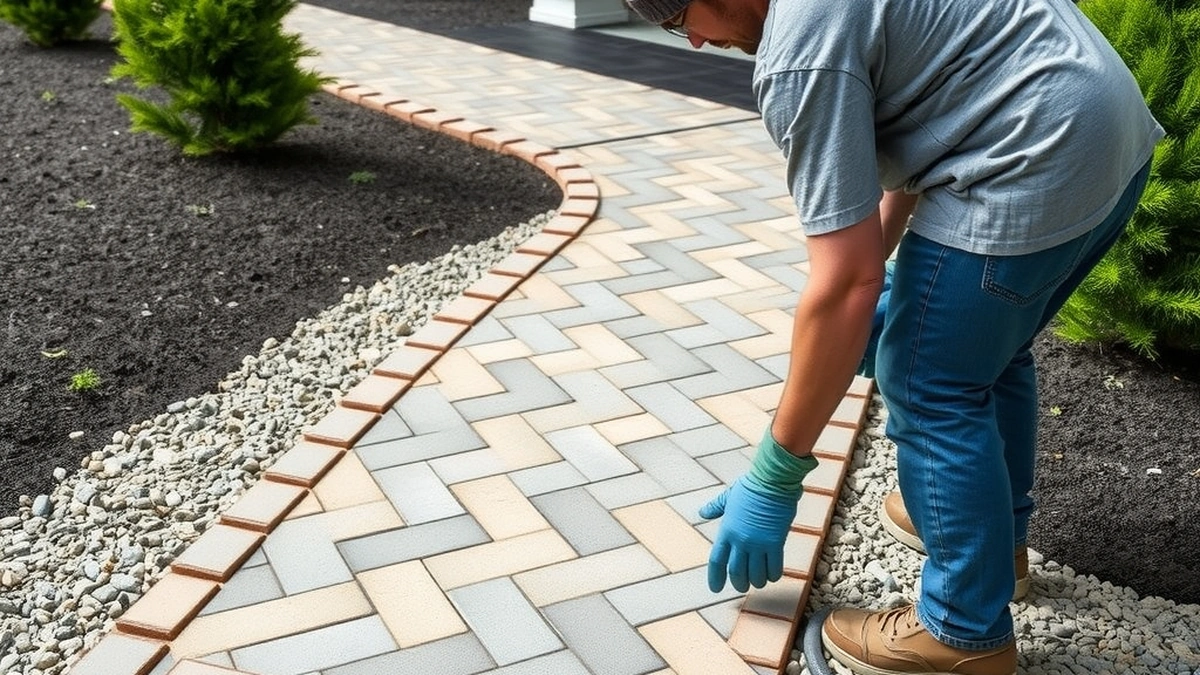
Excavate to 7 inches, compact 4 inches of gravel, set edge restraints, lay pavers with 1/8-inch joints, sweep in sand, and compact.
- Base depth
- 4-6 inches compacted gravel
- Slope
- 1/8 inch per foot away from structures
- Joint width
- 1/8 to 1/4 inch
- Installed cost
- $8-$30 per square foot
Some links on this page are affiliate links.If you buy through them we may earn a commission at no extra cost to you. We do not accept payment for rankings. Read the full disclosure.
A good paver patio walkway starts below the surface. Excavate the area, compact a crushed-stone base, set edge restraints, lay the pavers in your chosen pattern, and sweep joint sand into the gaps. Skipping base preparation almost always leads to settling, trip hazards, and costly repairs later.
Start With a Measured Layout
Mark the patio and walkway outline with spray paint or stakes and mason’s string. Measure the total square footage so you can order the right amount of material. For a rectangular space, multiply length by width. A 12-foot by 16-foot patio equals 192 square feet. Add 5 to 10 percent for cuts and breakage, which means ordering roughly 202 to 211 square feet of pavers.
Keep the layout simple at first. Straight lines and square corners are easier to excavate and screed than curves. If you want a curved walkway, lay out the curve with a garden hose, then mark it with paint. Understand that curves require more cutting and produce more waste.
Set the Proper Slope
Water must drain away from the house. Slope the finished surface at 1/8 inch per foot. On a 12-foot-wide patio, that is a 1.5-inch drop from the house to the outer edge. Establish this slope during excavation and carry it through the base and bedding sand layers.
Use a 4-foot level with a 1/2-inch shim under one end to check the slope quickly. If the bubble centers with the shim in place, you are close to 1/8 inch per foot. Poor slope causes puddles, ice in winter, and staining on the paver surface.
Excavate and Prepare the Base
Remove all grass, topsoil, and organic material. Dig to a depth that accommodates the base, bedding sand, and paver thickness. For most residential patios and walkways, plan on:
- 4 to 6 inches of compacted crushed stone base
- 1 inch of concrete sand bedding
- 2 to 3 inches of paver thickness
That totals roughly 7 to 10 inches of excavation. Compact the subsoil before adding stone. Run a plate compactor over the native soil in overlapping passes until it feels firm and does not shift underfoot.
Lay geotextile fabric over the subgrade if the soil is clay or holds moisture. The fabric separates the base stone from the soil and helps prevent the stone from sinking into soft ground over time.
Compact the Base Stone
Use crushed stone with angular edges, such as 3/4-inch minus or ASTM No. 57 stone, depending on local availability. Spread it in 2-inch lifts and compact each lift before adding the next. Do not place 6 inches of stone at once and expect one pass with a plate compactor to do the job.
For a 192-square-foot patio at 4 inches of compacted base, calculate the volume:
192 square feet × 0.33 feet = 63.4 cubic feet
63.4 ÷ 27 = 2.35 cubic yards of crushed stone
Order about 2.5 cubic yards to allow for compaction loss and grading adjustments. Compacted base should be firm enough that you cannot leave a footprint when walking on it.
Add Bedding Sand and Edge Restraints
Screed 1 inch of concrete sand over the compacted base. Use two 1-inch outside-diameter pipes as screed rails, pull a straight board across them, then remove the pipes and fill the indentations by hand. Do not walk on the screeded sand.
Install edge restraints along the perimeter before laying pavers. Plastic or metal restraints spiked into the base hold the pattern in place. Without them, pavers will creep outward under foot traffic and the joints will open up.
Edge restraints also define the transition between the paver patio walkway and adjacent lawn or planting beds. Set them tight against the excavation edge and backfill with soil after the pavers are set.
Choose and Lay the Pattern
Common patterns include running bond, herringbone, basket weave, and stack bond. Herringbone locks together well and works well for walkways with changing directions. Running bond is faster to install and produces fewer cuts on rectangular layouts.
Start from a straight edge, such as a house foundation or a snapped chalk line, and work outward. Keep joint widths between 1/8 and 1/4 inch. Use a rubber mallet to tap pavers down into the sand, and check level frequently with a 4-foot level.
Cut pavers with a masonry saw or a splitter. Wear eye and hearing protection when cutting. Follow the manufacturer’s guidance and OSHA recommendations for dust control, especially when dry-cutting concrete or stone products.
Sweep in Joint Sand and Compact
After all pavers are laid, spread dry joint sand over the surface and sweep it into the gaps. Run the plate compactor with a pad attachment to vibrate the pavers into the bedding sand and drive joint sand deeper into the joints. Add more sand and repeat until the joints are full.
Full joints prevent pavers from shifting and keep weeds from taking root. Do not use polymeric sand unless you are prepared to follow the manufacturer’s activation instructions exactly; improper activation leaves a haze on the surface.
Cost Estimates
Material costs vary by paver type. These are materials-only estimates per square foot:
| Paver type | Cost per square foot |
|---|---|
| Concrete pavers | $8-$15 |
| Brick pavers | $10-$20 |
| Travertine | $15-$30 |
| Permeable pavers | $12-$25 |
For that 192-square-foot patio with concrete pavers at $11 per square foot, materials cost roughly $2,112. Add base stone, bedding sand, edge restraints, joint sand, and equipment rental for the full project cost.
Sealing runs $1-$3 per square foot if you choose to seal later. Base repair, if an existing patio settles and needs rework, runs $4-$8 per square foot. These are estimates; actual prices depend on local labor rates and site conditions.
Maintenance After Installation
Sweep the surface regularly and rinse with a garden hose as needed. Re-sand joints if you notice sand loss after heavy rain. Inspect edge restraints annually to make sure they remain tight. If a paver cracks or settles, remove it, adjust the bedding sand, and replace the paver. For more on ongoing care, see our paver patio maintenance guide.
Layout is the step that determines whether a patio lasts ten years or thirty. Measure carefully, slope away from the structure, compact the base in lifts, and restrain the edges. The surface pattern is visible, but the base does the real work.
For design inspiration, browse our paver patio design ideas. If you want to integrate greenery, read about pavers in grass walkway. For full project pricing, see how much does paver patio cost.
Next, compare paver patio design ideas, pavers in grass walkway, how much does paver patio cost before you commit.
Frequently asked questions
How deep should the base be?
Excavate 7 inches total for a standard patio: 4 inches of compacted crushed stone plus roughly 1 inch of bedding sand and paver thickness.
What slope should a walkway have?
Slope the surface 1/8 inch per foot away from the house so water drains off instead of pooling against the foundation.
Do I need edge restraints?
Yes. Edge restraints keep pavers from spreading outward under foot traffic and prevent the pattern from unraveling over time.
How much do pavers cost?
Concrete pavers run $8-$15 per square foot, brick $10-$20, travertine $15-$30, and permeable pavers $12-$25, materials only.
Should I seal the pavers?
Sealing costs $1-$3 per square foot and can help resist stains, but it is optional and must be repeated every few years.
Can I lay pavers over grass?
No. Remove sod and organic soil first; grass will decompose and create voids that settle and crack the surface.
Sources
Some links are affiliate links.If you buy through them we may earn a commission at no extra cost to you. We do not accept payment for rankings. Read the full disclosure.