Concrete pavers vs Clay brick
Concrete pavers and clay brick compared on cost, frost performance, color fastness and maintenance, with the base work both materials need.
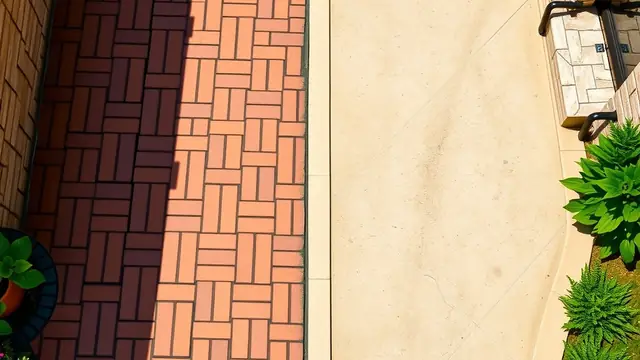
Concrete pavers cost $8 to $15 per square foot and clay brick $10 to $20. Concrete holds color with less variation and resists freeze-thaw well; clay brick develops a patina, stays cooler underfoot, and can spall in harsh winters if it is not the right grade.
- Concrete pavers
- $8 - $15 per square foot
- Clay brick
- $10 - $20 per square foot
- Base repair
- $4 - $8 per square foot
- Sealing
- $1 - $3 per square foot
Some links on this page are affiliate links.If you buy through them we may earn a commission at no extra cost to you. We do not accept payment for rankings. Read the full disclosure.
Concrete pavers and clay brick are both modular paving units laid on a compacted base, and both perform well when the base is right. The choice comes down to cost, color life and how each material behaves in freeze-thaw. Concrete pavers cost $8 to $15 per square foot; clay brick costs $10 to $20.
What each material is
Concrete pavers are manufactured from cement, aggregate and pigment, pressed into molds and cured. The color is in the mix and often in a surface layer, and the units are consistent in size.
Clay brick is fired clay. The color comes from the clay body and the firing temperature, so it runs through the unit rather than sitting on the surface. Sizes vary more than concrete pavers, and the surface has a natural texture.
Both are laid on a sand bedding over a compacted gravel base. The base specification does not change with the material. That is the part of the job that decides whether either patio stays flat, and it is identical for both.
Side by side
| Trait | Concrete pavers | Clay brick |
|---|---|---|
| Cost | $8 - $15 / sq ft | $10 - $20 / sq ft |
| Color life | Can lighten with age | Fired in, does not fade |
| Size consistency | High | Moderate |
| Surface | Uniform, textured | Natural variation |
| Freeze-thaw | Good with air-entrained mix | Good if the grade suits |
| Heat underfoot | Warmer in sun | Cooler |
| Repair match | Easy with same batch | Hard after the lot changes |
The repair-match row is worth noting. Concrete pavers from a later production run may differ slightly in color, but a clay brick from a different lot can be visibly different. Buying 5 percent extra at installation is the usual hedge.
The arithmetic on 200 square feet
Concrete pavers at $11 per square foot: 200 × $11 = $2,200.
Clay brick at $15 per square foot: 200 × $15 = $3,000.
Base repair, if needed, is $4 to $8 per square foot: 200 × $6 = $1,200. That applies to either material.
Sealing at $2 per square foot: 200 × $2 = $400.
So the material choice moves the total by $800 on a 200 square foot patio, while the base work moves it by $1,200. The base is the bigger line.
Where concrete pavers win
Cost is the main advantage, and it compounds on a large patio. At $8 to $15 per square foot, concrete is the more affordable option across a driveway or a large patio, where the difference against brick can run to four figures.
Consistency is the second. Uniform sizes and a wide range of shapes make pattern design easier and cutting faster. That speed shows up in the labor line on a patio with curves and borders, where every cut is time.
Availability is the third. Concrete pavers are stocked widely, so a replacement unit is usually a phone call away. That matters more than buyers expect when a paver cracks three years after installation.
Where clay brick wins
Color life is the main advantage. The color is fired into the clay, so it does not fade or wear off the surface. A brick patio that is 30 years old often looks better than a concrete one of the same age.
Appearance is the second. Brick has a warmth and variation that concrete reproduces but does not match, especially at close range. At a distance the difference is subtle; up close, the fired surface has a depth that a pigmented face does not.
Heat is the third. Brick stays cooler underfoot in direct sun, which matters on a patio used barefoot in summer. The difference is noticeable on a hot afternoon and is one of the reasons brick remains popular in warmer climates.
Freeze-thaw and spalling
In cold climates, the material’s absorption matters. A brick that absorbs water and then freezes can spall, losing its face in flakes. That is why brick made for cold climates is fired harder and specified by absorption rate.
The fix is to specify a brick rated for freeze-thaw and to build a base that drains. A saturated base under any material accelerates damage.
Concrete pavers are generally air-entrained for freeze-thaw resistance, but a paver that is saturated and repeatedly frozen can still crack.
Maintenance differences
Both materials need joint sand, weeding and occasional sealing. Brick may need more weed attention because the joints are often wider and the surface is more textured.
Efflorescence is more common on clay brick and on concrete, and both can be treated the same way: dry brush, mild acid wash, rinse.
Staining differs. Concrete is more porous and absorbs oil; brick is denser and stains less, but mortar and efflorescence are more visible on it. A brick patio also shows algae in shaded areas, especially in a wet climate.
Choosing between them
- Set the budget with the base work included, not just the material.
- Check the freeze-thaw rating for the material in your climate.
- Decide how much color variation you want.
- Confirm the base depth and drainage for your soil.
- Ask about replacement availability for the specific unit.
- Price sealing at $1 to $3 per square foot for either.
For the base that both need, read paver base preparation. For the cost lines, see concrete pavers cost and clay brick cost, and for the installation method, check paver patio installation.
Frequently asked questions
Are clay bricks better than concrete pavers?
Neither is better in every case. Clay brick has a warmer look and a longer color life, while concrete pavers cost less and offer more shapes and sizes.
Which handles freeze-thaw better?
Both can perform well if the brick or paver is rated for freeze-thaw and the base drains. Clay brick that absorbs water can spall, so the grade matters.
Do clay pavers fade?
The color is fired into the clay, so it does not fade the way a surface-applied concrete color can. Concrete pavers can lighten over years of sun and traffic.
How much does a clay brick patio cost?
Clay brick runs $10 to $20 per square foot installed. A 200 square foot patio at $15 is 200 × $15 = $3,000 before base repair or sealing.
Do brick pavers need sealing?
Not always. Sealing at $1 to $3 per square foot helps with staining and weed resistance, but many brick patios are left unsealed and perform well.
Can the two materials be mixed?
Yes, and it is common for borders and accents. Keep the base continuous across the transition so the two do not settle differently.
Sources
Some links are affiliate links.If you buy through them we may earn a commission at no extra cost to you. We do not accept payment for rankings. Read the full disclosure.