Weeds in joints: warning signs
The early signs that paver joints are failing: sand loss after rain, moss in shade, widened joints and spreading edges, before weeds take hold.
The first sign is sand sitting on the pavers or in a line at the low edge after rain, which means the joints are washing out. Moss, widened joints and a spreading outer course follow, and the weeds arrive once the gap holds soil.
- Earliest sign
- Sand trails after rain
- Second sign
- Joints sitting below the chamfer
- Third sign
- Moss in shaded joints
- Late sign
- Outer course spreading
Some links on this page are affiliate links.If you buy through them we may earn a commission at no extra cost to you. We do not accept payment for rankings. Read the full disclosure.
Weeds in paver joints have warning signs that appear long before the first sprout. Sand on the pavers after rain, joints sitting below the chamfer, moss in shaded areas and an outer course that has started to spread all point to the same problem: the joint is open and water is moving through it.
Sand where it should not be
The clearest early sign is sand on the surface after a storm, especially in a line along the low edge or against a wall. That sand came out of the joints.
A few grains are normal. A visible drift or a fan of sand at the edge means the fill is washing out faster than it can be replaced.
Check the joints in the same area. If they are visibly lower than the surrounding pavers, the diagnosis is confirmed.
Photograph the drift before sweeping it up. The shape of the sand trail shows where the water went, and that is the place to check the slope.
Joints below the chamfer
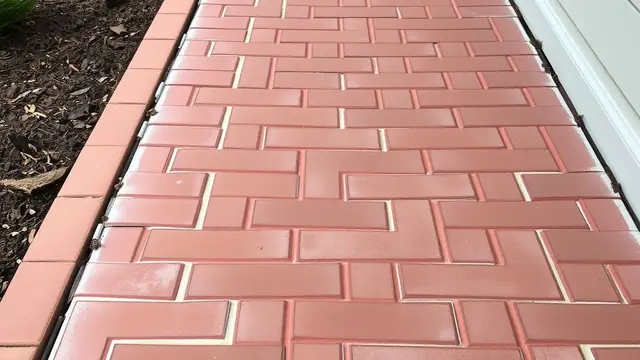
A properly filled joint sits just below the chamfered edge of the paver. The fill is firm and the gap is shallow.
A failing joint sits a quarter inch or more below the surface, and a screwdriver pushed into it sinks through loose sand. That depth is where water collects and where seed germinates.
This is the sign most homeowners miss, because the patio still looks level from standing height. Get down at eye level with a torch or a low sun and the depth becomes obvious.
The signs in order
| Sign | What it means | Urgency |
|---|---|---|
| Sand trails after rain | Fill is washing out | Low, act this season |
| Joints below chamfer | Gap is open and collecting | Low to medium |
| Moss in shaded joints | Joint stays damp | Medium |
| Small sprouts in joints | Seed has a seedbed | Medium |
| Water pooling on pavers | Slope or drainage issue | High |
| Outer course spreading | Edge restraint has failed | High |
| Pavers rocking underfoot | Base is softening | High |
The bottom three are the ones that turn a re-sand into a base repair.
The order is not fixed. A patio can go from sand trails to rocking pavers in one wet winter if the base is shallow, which is why the spring inspection matters more than the autumn one.
Moss and what it tells you
Moss grows where moisture persists and light is low. In a joint, that means the fill is staying wet, which usually points to a shallow slope, shade, or a fill that has become organic and water-retentive. In a north-facing patio, some moss is unavoidable and is a maintenance item rather than a failure.
Moss is not the cause of the failure, but it is a reliable indicator that water is not leaving the surface quickly. Removing the moss without correcting the drainage guarantees it returns.
The same applies to algae, which appears as a green or black film on shaded pavers and in joints that stay damp.
Spreading edges and rocking pavers
An outer course that has moved outward is an edge restraint failure. The pavers push against the border, the border gives way, and the joints behind it open. On a driveway, that spreading can be a foot or more over a season because the tires push outward on every turn.
Rocking pavers are a base failure. Water has reached the bedding, the sand has migrated, and the paver now spans a void.
Both are past the point where a re-sand fixes anything. Base repair at $4 to $8 per square foot is the correct spend, and it is cheaper than waiting until the pavers crack.
Water pooling as the underlying signal
Standing water on a patio after rain is the clearest sign that the slope is wrong or the drainage outlet is blocked. Every other joint problem tends to follow.
The fix is to correct the slope or add a drain, not to add more sand. A re-sand on a patio that ponds will fail in the same low spot within a season.
The inspection routine
- Walk the patio after rain and photograph where sand has moved.
- Check joint depth with a screwdriver in five or six places.
- Look for moss, algae and organic matter in shaded joints.
- Step on each paver and listen for a hollow sound.
- Check the outer course for spreading.
- Look for standing water and note where it drains.
That routine takes ten minutes and tells you whether the patio needs a top-up, a re-sand, or a base repair. Keep a note of the dates; a joint that loses its fill twice in a year is telling you something the sand alone cannot fix.
What the signs mean for cost
A top-up costs a bag of sand. A re-sand at $2 to $4 per square foot is $400 to $800 on 200 square feet. A base repair at $4 to $8 per square foot is $800 to $1,600 before re-sanding.
The earlier the sign is caught, the cheaper the fix. Sand on the pavers in spring is a warning; rocking pavers in summer is a bill.
For the repair sequence, read weeds in joints repair options. For the cost details, see weeds in joints cost, and for the prevention routine, check weeds in joints prevention.
Frequently asked questions
What does joint washout look like?
A line of sand on the pavers or at the low edge after rain, and joints that sit visibly lower than the paver surface. The fill is leaving the joint and moving downhill.
Why is moss a warning sign?
Moss needs persistent moisture. It grows where a joint stays damp, which usually means the fill is holding water or the slope is not draining.
Are wide joints always a problem?
Wide joints are normal in some paver styles, but joints that have widened since installation point to spreading or settlement, and they take more sand and more water.
How can I tell if the joint is full?
The fill should sit just below the chamfer, not a half inch down. A screwdriver pushed into the joint should meet firm resistance rather than sinking into loose sand.
Why does the outer course spread?
Missing or failed edge restraint. Without a border holding the field, traffic and water push the outer pavers outward and the joints open behind them.
When should I stop topping up and re-sand?
When the fill is gone across most of the patio, or when topping up fails within a season. That is the point for a full re-sand rather than spot repairs.
Sources
Some links are affiliate links.If you buy through them we may earn a commission at no extra cost to you. We do not accept payment for rankings. Read the full disclosure.