Weeds in joints: how to prevent it
Stop weeds between pavers by keeping joints full, holding the edges and moving water off the patio, with the base and sand choices that decide it.
Weeds are prevented by full joints of polymeric sand, a restrained edge, a base that drains, and a slope that moves water off the patio. A weed barrier under the pavers helps only when the joint stays filled, because seed lands from above.
- Best joint fill
- Polymeric sand at full depth
- Edge
- Restraint on all open sides
- Slope
- 2 percent away from the house
- Re-sand interval
- Every 3 - 5 years
Some links on this page are affiliate links.If you buy through them we may earn a commission at no extra cost to you. We do not accept payment for rankings. Read the full disclosure.
Weeds between pavers are prevented by keeping the joint full, holding the edge, and moving water off the surface. A full joint of polymeric sand leaves no soil for a seed, a restrained edge stops the field spreading, and a 2 percent slope keeps water from pooling and washing the fill out. Prevention is a base and joint discipline, not a herbicide.
Where the weeds actually come from
Most weed seed arrives on the wind and lands on the patio surface. It germinates where there is a gap with damp sand and a bit of organic matter.
That is why a weed barrier under the pavers is only half the answer. It stops seed from below, but the seed that matters is landing from above, in the joint.
The second source is the patio edge. Grass and soil meet the pavers there, and seed washes or blows into the border. An edge restraint and a clean gravel or mulch strip reduce it.
Prevention measures and what they do
| Measure | Effect | Effort |
|---|---|---|
| Polymeric sand at full depth | Removes the seedbed | Medium |
| Edge restraint | Stops the field spreading | Medium, at install |
| 2 percent slope | Moves water off | Set at install |
| Geotextile under base | Stops fines migrating | Set at install |
| Gravel border strip | Removes seed source at edge | Low |
| Twice-yearly joint check | Catches washout early | Low |
| Sealing every 3 - 5 years | Holds sand, slows water | Medium |
The first three do most of the work. The rest are maintenance and detailing.
Joint fill: the decision that matters
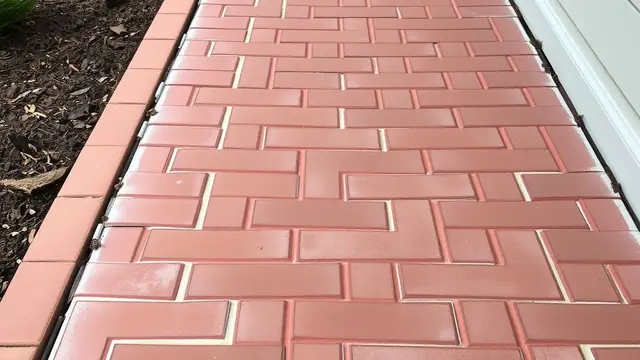
Polymeric sand is the default for a dry-laid patio. It is swept into the joint, compacted and misted, and the polymer binds the grains into a firm fill that resists washout.
Plain sand is cheaper and easier, but it has no binder. It washes out faster, needs topping up more often, and leaves a loose surface that seed can root in.
Fine gravel is an option for a rustic patio with wide joints. It drains well and looks appropriate with flagstone, but it collects organic matter and needs periodic top-up.
The fill has to go to full depth. A joint filled only at the top looks finished and fails within a season.
Edge restraint and slope
An edge restraint is a hidden or visible border that holds the paver field in place. Without one, the outer course spreads, the joints open, and water gets in.
The slope should be about 2 percent away from the house, which is a quarter inch per foot. On a 10 foot run that is 2.5 inches of fall.
Water that runs across the patio instead of off it will find the lowest joints and wash them out. That is why a re-sand without a slope correction often fails in the same place.
What not to use
Herbicides kill the plant and leave the seedbed. A pre-emergent applied to a patio surface does not stop seed that lands after the application, and it does nothing about the open joint.
Weed torches burn the growth and can scorch the paver face. They also leave the root and the organic matter in the joint, which is the material the next seed needs.
Plastic sheeting under the pavers is not a barrier. It tears during installation, blocks drainage, and creates a wet layer that softens the bedding.
Salt and vinegar are non-selective and can stain or etch certain pavers. They are a short-term clearance, not a prevention measure.
The base decides how long prevention lasts
A base of 4 inches of compacted gravel over geotextile keeps the pavers stable and drains water away. A thin base consolidates unevenly, the pavers move, and the joints open.
Base repair at $4 to $8 per square foot is the cost of getting this wrong. On a 200 square foot patio at $6, that is 200 × $6 = $1,200, which is far more than the cost of doing the base properly the first time.
Geotextile is a small line item that stops fines from the subgrade migrating into the gravel. Without it, the gravel clogs, drainage slows, and water sits under the pavers.
A prevention routine
- Sweep the patio monthly so organic matter does not collect in the joints.
- Check the joints twice a year, especially after winter.
- Top up low joints with polymeric sand and mist to set.
- Keep the edge strip clear of soil and grass.
- Check the slope at the low edge after heavy rain.
- Re-sand the full patio every 3 to 5 years.
- Seal after re-sanding if the surface is porous.
What prevention costs
Polymeric sand for 200 square feet is two to three bags, roughly $50 to $105 in material. A professional re-sand at $2 to $4 per square foot is $400 to $800.
Sealing at $1 to $3 per square foot is $200 to $600 on the same patio, and it extends the life of the joint fill.
Compare those numbers with a base repair at $1,200 or more. The prevention spend is a fraction of the repair, and it is the difference between a patio that needs an afternoon every few years and one that needs rebuilding.
For the repair method when weeds are already established, see weeds in joints repair options. For the cost breakdown, read weeds in joints cost, and for the base specification, check paver base preparation.
Frequently asked questions
Does landscape fabric stop weeds between pavers?
It slows them but does not stop them, because most seed lands on the surface and germinates in the joint. A full joint of polymeric sand matters more than fabric.
What is the best sand for paver joints?
Polymeric sand for a dry-laid patio. It hardens after misting, resists washout and leaves a firm surface that seed cannot root in.
Why do weeds grow at the patio edge?
The edge is where grass and soil meet the pavers and where restraint is often missing. An edge restraint and a clean border strip remove the seed source.
Does sealing prevent weeds?
It helps by slowing water absorption and holding the joint sand, but it does not fill a gap. Seal only after the joints are full.
How often should joints be topped up?
Check twice a year and top up when the sand sits below the chamfer. A full re-sand every 3 to 5 years is typical.
Can weeds push pavers apart?
Large roots can lift pavers, and persistent growth widens joints over time. The bigger risk is the water that follows the open joint into the base.
Sources
Some links are affiliate links.If you buy through them we may earn a commission at no extra cost to you. We do not accept payment for rankings. Read the full disclosure.