Flagstone vs Concrete pavers
Flagstone and concrete pavers compared on cost, installation, freeze-thaw performance and maintenance, with the base work both systems need.
Concrete pavers cost $8 to $15 per square foot and come in uniform sizes; flagstone is natural stone sold by the ton, laid in irregular shapes, and usually costs more. Both need a compacted base and drainage, and both can be dry-laid.
- Concrete pavers
- $8 - $15 per square foot
- Flagstone
- Priced by the ton
- Base repair
- $4 - $8 per square foot
- Sealing
- $1 - $3 per square foot
Some links on this page are affiliate links.If you buy through them we may earn a commission at no extra cost to you. We do not accept payment for rankings. Read the full disclosure.
Flagstone and concrete pavers are both dry-laid patio materials, and both live or die on the base beneath them. The differences are cost, install time, and how each handles irregularity: pavers are uniform and fast, flagstone is natural and slower, and concrete pavers at $8 to $15 per square foot are easier to budget than stone sold by the ton.
What each material is
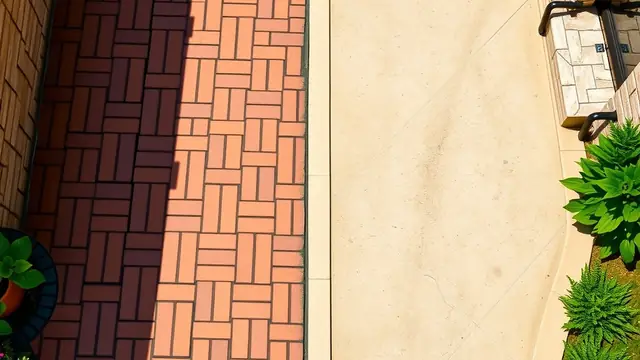
Concrete pavers are manufactured units, typically 2 to 3 inches thick, molded in consistent sizes and shapes with chamfered edges. They are laid in patterns and compacted into a sand bedding.
Flagstone is natural stone, split or sawn to 1 to 2 inches for patios and thicker for driveways. Pieces are irregular, and each one has to be fitted to its neighbors.
Both go on a compacted gravel base with a sand bedding layer. The base specification does not change with the material.
Side by side
| Trait | Concrete pavers | Flagstone |
|---|---|---|
| Cost | $8 - $15 / sq ft | Priced by the ton |
| Uniformity | Consistent sizes | Irregular pieces |
| Install speed | Fast | Slow |
| Cutting | Saw or guillotine | Saw, chisel, or hand fit |
| Look | Regular, manufactured | Natural, one-of-a-kind |
| Repairability | Lift and relay units | Lift and reset stones |
| Joint fill | Polymeric sand | Polymeric sand or gravel |
| Base requirement | 4 inches compacted | 4 inches compacted |
The base row is identical because the failure modes are identical. A thin base under pavers produces the same rocking and settling as a thin base under stone, and it costs the same $4 to $8 per square foot to correct either one.
The arithmetic on 200 square feet
Concrete pavers at $11 per square foot are 200 × $11 = $2,200. Base repair, if the base has to be rebuilt, is $6 per square foot: 200 × $6 = $1,200. Sealing at $2 is 200 × $2 = $400.
Flagstone is priced by the ton, so the material line depends on thickness and coverage. A thicker stone covers less area per ton and costs more to handle. Ask for the tonnage and the expected coverage in writing, then compare the total installed price rather than the material price.
The surrounding work is the same for both: excavation, geotextile, 4 inches of compacted gravel, 1 inch of bedding, and joint fill. That work is where the $4 to $8 per square foot base rate applies.
Where concrete pavers win
Speed is the main advantage. Uniform units lay quickly, and a 200 square foot patio is a two-day job for an experienced crew. That speed is also why the installed price per square foot stays predictable.
Predictable cost is the second. Pavers are sold per square foot, so a budget can be built before the work starts, with a known allowance for cuts and breakage.
Repair is the third. A damaged paver is lifted and replaced with an identical unit, and the repair is invisible.
Where flagstone wins
Appearance is the reason to choose it. No two stones are alike, the surface has natural variation, and a flagstone patio reads as stone rather than as a manufactured product. That also means the patio cannot be matched later if a section is replaced, because the stone lot changes.
Thermal behavior is the second. Stone stays cooler underfoot than concrete in direct sun, which matters on a patio used barefoot in summer.
Age is the third. Flagstone develops a patina and looks better as it weathers, while concrete pavers fade and can look tired after a decade.
Installation differences that affect the price
Flagstone takes longer because every piece has to be fitted. Cutting irregular stone with a saw or chisel, adjusting the bedding under each piece, and filling wide joints all add labor.
Concrete pavers also need cutting at edges, but the field is repetitive and fast. The labor difference is the main reason flagstone costs more per square foot even when the stone itself is affordable.
Both need an edge restraint. Without one, the field spreads outward and the joints open. On a patio that meets a lawn, the restraint is often hidden under the turf edge, and it is the first thing to check when the outer course starts to spread.
Which holds up better
Both hold up well when the base drains. In freeze-thaw climates, the base depth and drainage matter more than the material.
Flagstone has an edge in repairability after heave: individual stones can be lifted, the bedding corrected, and the stone reset. A paver field can also be lifted and re-laid, but the interlock has to be rebuilt across a larger area.
Concrete pavers have an edge in uniformity after repair, because a replacement unit matches the original. That matters on a patio where a mismatched patch would be visible from the kitchen window.
Choosing between them
- Set a budget per square foot for the finished patio, not the material.
- Confirm the base specification in writing: 4 inches compacted, geotextile, 1 inch bedding.
- Check the slope and the drainage outlet before choosing a material.
- Decide how much irregularity you want in the pattern.
- Ask for the flagstone tonnage and coverage if you go natural.
- Price sealing for either material at $1 to $3 per square foot.
For the base work that both need, read paver base preparation. For the flagstone method, see flagstone installation, and for concrete paver costs, check concrete pavers cost.
Frequently asked questions
Is flagstone more expensive than concrete pavers?
Usually yes. Concrete pavers run $8 to $15 per square foot installed, while flagstone is sold by the ton and priced by thickness and coverage, which typically lands higher for the same area.
Which is easier to install?
Concrete pavers. Uniform sizes and interlocking edges make layout faster, while flagstone requires cutting and fitting irregular shapes and adjusting bedding under each stone.
Which handles freeze-thaw better?
Both handle it well when the base drains. Flagstone is more forgiving of minor movement because individual stones can be reset, while a heaved paver field can be re-laid after lifting.
Do concrete pavers look artificial?
Modern pavers are molded and textured to resemble stone, brick and cobble. At a distance they read as natural; close up, the repetition of identical units is visible.
Which adds more resale value?
Neither reliably. A well-built patio adds usable outdoor space, but buyers rarely pay a premium for the material alone unless the whole landscape is high-end.
Can I mix flagstone and pavers?
Yes, and it is common: flagstone as a landing or border and pavers for the main field. The base must be continuous across both so the transition does not settle.
Sources
Some links are affiliate links.If you buy through them we may earn a commission at no extra cost to you. We do not accept payment for rankings. Read the full disclosure.