Flagstone problems
The failures flagstone patios actually develop: rocking stones, sand washout, frost heave, cracked slabs and staining, with the base cause of each.
Most flagstone problems trace to the base or the water: rocking stones from thin or poorly compacted gravel, sand washout from missing geotextile, frost heave from a shallow excavation, and staining from iron or organic matter in the stone.
- Most common
- Rocking and settling stones
- Root cause
- Base thickness and compaction
- Second cause
- Water running under the patio
- Base repair
- $4 - $8 per square foot
Some links on this page are affiliate links.If you buy through them we may earn a commission at no extra cost to you. We do not accept payment for rankings. Read the full disclosure.
Flagstone problems are almost always base problems or water problems. Rocking stones come from an uneven or thin base, sand washout comes from water moving through the joints, and frost heave comes from water freezing under a shallow excavation. The stone itself is durable; the layer beneath it is what fails.
Rocking and settling
A rocking stone pivots when weight crosses it. The cause is a high spot in the bedding sand or a void beneath the stone, and both come from the base.
If the gravel was placed in one thick lift, the lower part never reaches full compaction. Traffic then consolidates it unevenly, and the stones above follow.
The fix is to lift the stone, check the bedding, and reset it on a full sand bed. If several stones in one area rock, the base beneath them needs to be excavated and recompacted rather than patched stone by stone.
Sand washout
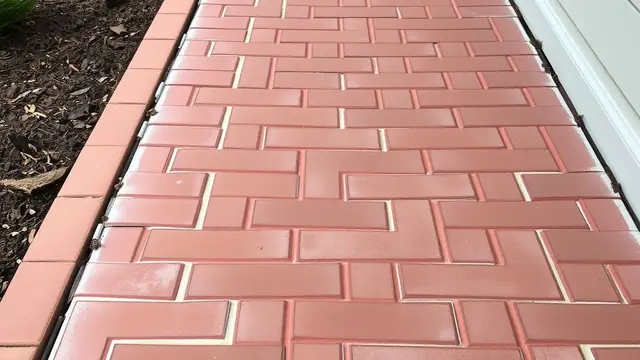
Sand disappearing from the joints is a drainage symptom. Water flowing across the patio finds the joints, carries the bedding sand down into the gravel, and leaves the stones unsupported.
Geotextile between the gravel and the sand slows that migration. A joint fill that has degraded, or one that was never completed to full depth, lets water in faster. A joint that is only half filled looks finished from standing height and acts as an open channel in the first heavy rain.
The repair is to refill the joints with polymeric sand or fine gravel and address the slope so water leaves the surface rather than soaking into it.
Frost heave
| Sign | Cause | Fix |
|---|---|---|
| Stones lifted in one area | Water freezing in the base | Improve drainage, deepen base |
| Patio highest in the middle | Frost-susceptible subgrade | Excavate and replace |
| Joints open in spring | Heave then settlement | Reset stones, refill joints |
| Cracks in stone | Point load over a void | Reset on full bed |
| Edge stones pushed out | No edge restraint | Add a restrained edge |
Heave is seasonal: the patio lifts in winter and settles in spring, and the stones end up out of level. In cold climates, the base depth has to go below the frost line, or the patio has to drain so well that no water remains to freeze.
A patio that heaves in one corner and not the rest is usually sitting on a subgrade that holds water, such as clay or silt. Replacing that material with free-draining gravel over geotextile is the durable fix, and it is a base repair rather than a stone repair.
Staining
Flagstone stains from three sources: iron minerals in the stone, organic matter such as leaves and tannins, and efflorescence from the base or the mortar.
Iron staining appears as orange or rust-colored patches and is often worse after rain. Organic staining is dark and follows the shape of whatever sat on the stone. Efflorescence is white and chalky and wipes away as powder.
Each needs a different cleaner. An iron remover, an organic cleaner, and a plain water rinse with a soft brush are not interchangeable, and using the wrong one can set the stain.
Cracking and broken edges
Thin flagstone cracks when it spans a void. The stone is strong in compression but weak in bending, and a 1 inch stone over a 2 inch hollow will break under a foot traffic load.
Edges break when there is no restraint. A patio that meets grass with no edging loses stones outward as the grass edge is trimmed and walked on.
Both are installation defects rather than material defects. A full sand bed and a restrained edge prevent them. So does choosing a stone thick enough for the load: 1 inch is fine for foot traffic, but a walkway that takes a wheelbarrow or a vehicle needs 2 inches or more.
Why the base is the whole story
The base repair rate of $4 to $8 per square foot is the number that decides most repairs. A patio with widespread rocking or heave needs the base rebuilt, not the stones reset.
On a 200 square foot patio, base repair at $6 per square foot is 200 × $6 = $1,200. Add stone replacement for broken pieces and the total rises, but the base is the mandatory part.
Compare that with resetting a handful of stones: a few hours of labor and a bag of sand, adequate only when the base is sound and the problem is local.
Diagnosing a flagstone problem
- Walk the patio and mark every stone that moves.
- Lift one rocking stone and look at the bedding: a hollow means the base is uneven.
- Check the slope with a level; water should run away from the house.
- Look for sand trails in the joints after rain, which indicate washout.
- Note whether the problem is seasonal, which points to frost.
- Check the edge for restraint and for stones pushed outward.
The pattern of the failures tells you whether the fix is local or structural. A single rocking stone near a downspout is a drainage issue; ten rocking stones across the middle are a base issue. Write down which stones move and when, because a seasonal pattern is a different problem from a constant one.
For the installation method that prevents these failures, see flagstone installation. For cleaning and joint care, read flagstone maintenance, and for the cost of a base rebuild, check the paver repair cost guide.
Frequently asked questions
Why do my flagstones rock?
A rocking stone sits on a high spot in the bedding sand rather than a full bed. The base beneath it is usually uneven or under-compacted, so the stone pivots when weight crosses it.
Why does sand wash out from between flagstones?
Water is running through the joints and taking the bedding with it. Missing geotextile, a slope toward the joints, or a joint fill that has degraded all contribute.
What causes flagstone to heave in winter?
Frost heave happens when water in the base freezes and expands. A shallow excavation or a base that does not drain leaves water where it can freeze under the stone.
Can stained flagstone be cleaned?
Iron staining and organic staining can often be removed with a targeted cleaner, but the stain may return if the source, usually water or mineral content, is still present.
Do flagstones crack?
Thin stone over an uneven base cracks under load. Thick stone over a sound base rarely does, which is why base preparation matters more than stone thickness.
How much does it cost to fix a failed flagstone patio?
Base repair runs $4 to $8 per square foot. A full rebuild of a 200 square foot patio at $6 per square foot is $1,200 before any stone replacement.
Sources
Some links are affiliate links.If you buy through them we may earn a commission at no extra cost to you. We do not accept payment for rankings. Read the full disclosure.