Efflorescence: warning signs
How to recognise efflorescence early: white bloom at joints, a crust that returns after rain, and the difference from salt, lime and sealer haze.
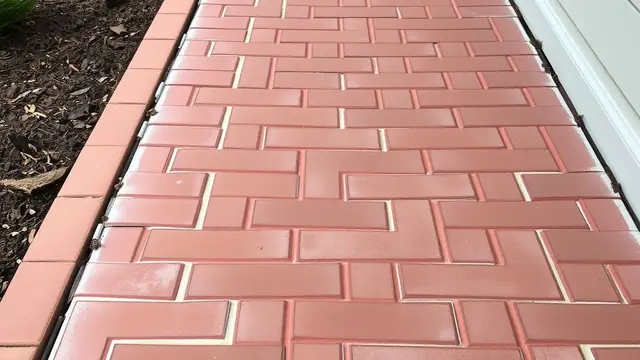
Efflorescence appears as a white, powdery bloom at the surface, strongest along joints and in bands where water evaporates. It brushes off as powder and returns after rain, which is what separates it from sealer haze and lime staining.
- Appearance
- White, powdery bloom
- Location
- Joints and damp bands
- Test
- Brushes off as powder
- Return pattern
- Comes back after rain
Some links on this page are affiliate links.If you buy through them we may earn a commission at no extra cost to you. We do not accept payment for rankings. Read the full disclosure.
Efflorescence looks like white powder on the surface, concentrated at joints and in bands where water evaporates. The reliable test is that it brushes off as a powder and comes back after rain. Sealer haze does not brush away, and dirt does not reappear in the same pattern.
The appearance
The bloom is white to grey-white, powdery when thin and crusty when heavy. It sits on the paver face and in the joints rather than staining the material. Under a fingernail it feels like chalk, not grit.
On a new patio it often appears as a light dusting across the whole surface. On an older patio it tends to appear in defined bands or patches, which is more diagnostic.
The band pattern follows the moisture. Look for it near a wall, along a low edge, or at the boundary between a shaded area and a sunlit one.
The brush test
Brush a small area with a stiff dry brush. Efflorescence comes off as a powder and the paver underneath looks normal.
Sealer haze does not come off with a brush. It is a film bonded to the surface, and it usually appears shortly after sealing.
Dirt comes off too, but it is dark and greasy rather than white and crystalline, and it does not return in the same pattern after rain.
The signs in order
| Sign | What it means | Action |
|---|---|---|
| Light white dusting | Initial drying bloom | Brush and wait |
| White crust at joints | Salt moving through joints | Brush, check drainage |
| Bloom in a band after rain | Water path through the patio | Investigate the source |
| Bloom only near a wall | Water trapped at the edge | Check slope and downspout |
| Bloom under a sealer | Moisture trapped by film | Strip and reseal breathable |
| Surface scaling on brick | Repeated salt cycles | Assess for replacement |
The band pattern is the most useful sign because it points to the water source rather than just the symptom.
Telling it apart from other white deposits
Lime staining comes from mortar or concrete and is usually associated with a construction detail, not the whole patio. It does not brush off as readily and often has a harder, more defined edge.
Salt from de-icing can leave a white residue, but it is concentrated where the salt was applied and washes away with the first rain.
Sealer haze is a uniform film, often with a slight sheen, and it appears immediately after sealing rather than after wet weather.
Efflorescence is the one that brushes off, returns after rain, and follows a moisture pattern. Once you have seen all four side by side, the distinction becomes obvious in the field.
A simple field test
Brush a teaspoon of the powder into a clear cup and add water. Efflorescence salts largely dissolve, and the water stays clear or slightly cloudy. Dirt leaves sediment and colored water.
A drop of mild acid on a sample will fizz if the deposit is carbonate-based, which is common in efflorescence. This test should be done on a spare paver or a hidden area, not on the visible surface.
The inspection routine
- Photograph the bloom before touching it, with a tape measure for scale.
- Brush a small area and check whether the powder lifts cleanly.
- Note whether the bloom follows joints, a wall, or a low edge.
- Check the slope with a level and watch where water runs in rain.
- Look at the downspouts and confirm they discharge past the patio.
- Re-check after the next rain to see whether the pattern repeats.
That sequence separates a harmless drying bloom from a drainage problem, and it gives you a record to show a contractor if the pattern persists.
Why the pattern matters more than the amount
A light dusting across a new patio is normal. A heavy crust in one band after every rain is a drainage signal.
The location tells you where the water is entering and leaving. Bloom along the house wall suggests water running toward the foundation. Bloom at a low edge suggests the patio is draining to that point and soaking in. Bloom in the middle of the field is the hardest case, because the water is coming from below rather than from the surface.
That is why the first step after identifying efflorescence is to photograph it, not to clean it. The photograph preserves the evidence of where the water is going, and it is the difference between treating a symptom and fixing a cause.
A bloom that appears in the same place every spring is following a seasonal water table or a spring melt path. A bloom that appears after every summer storm is following surface flow. Those two need different fixes, and the calendar is part of the diagnosis.
What the signs mean for cost
Cleaning a light bloom is a brush and a dry afternoon.
A persistent band needs a drainage fix, which may mean regrading, a downspout extension, or a base repair at $4 to $8 per square foot. On 200 square feet at $6, that is $1,200.
Sealing after the fix at $1 to $3 per square foot is 200 × $2 = $400. On a patio where the bloom keeps returning, that sealing spend is wasted until the drainage is corrected, which is why the order of work matters.
For the removal methods, read efflorescence repair options. For prevention, see efflorescence prevention, and for the cost detail, check the efflorescence cost guide.
Frequently asked questions
What does efflorescence look like on pavers?
A white or grey-white powdery deposit on the surface, often concentrated along joints and in bands. It can look like a light dusting or a thick crust.
How do I tell efflorescence from sealer haze?
Efflorescence brushes off as powder and returns after wet weather. Sealer haze is a film that does not brush away and usually appears right after sealing.
Does efflorescence appear only on new pavers?
No. New pavers bloom as they dry, but older patios can bloom too when water starts moving through the base or the joints.
Why does the bloom appear in bands?
The bands mark where water evaporates fastest, usually at joints, edges, and the boundary between sun and shade. They trace the moisture path through the patio.
Is white bloom harmful?
Mostly cosmetic, but repeated cycles can scale the surface of clay brick. Persistent bloom also signals a drainage problem that will cause settling later.
Can I test whether it is efflorescence?
Brush a sample into a cup and add water. Efflorescence salts largely dissolve; dirt and sealer residue do not. A fizzing reaction with mild acid also indicates carbonate salts.
Sources
Some links are affiliate links.If you buy through them we may earn a commission at no extra cost to you. We do not accept payment for rankings. Read the full disclosure.