Efflorescence: repair options
How to remove white efflorescence from pavers and stop it returning: dry brushing, washing, poultices and the drainage fix behind it.
Efflorescence is salt pushed to the surface by water moving through the paver or the base. Remove it with a dry brush first, then a mild acid wash or poultice if needed, and fix the water source or it returns within a season.
- First step
- Dry brush, no water
- Second step
- Mild acid wash or poultice
- Root cause
- Water moving through the material
- Sealing
- $1 - $3 per square foot
Some links on this page are affiliate links.If you buy through them we may earn a commission at no extra cost to you. We do not accept payment for rankings. Read the full disclosure.
Efflorescence is salt, not dirt. Water dissolves salts inside the paver or the bedding and carries them to the surface, where the water evaporates and leaves a white bloom. Scrubbing with water can make it worse. The repair is a dry brush first, a mild acid wash or poultice second, and a fix for the water source or it comes back.
What efflorescence actually is
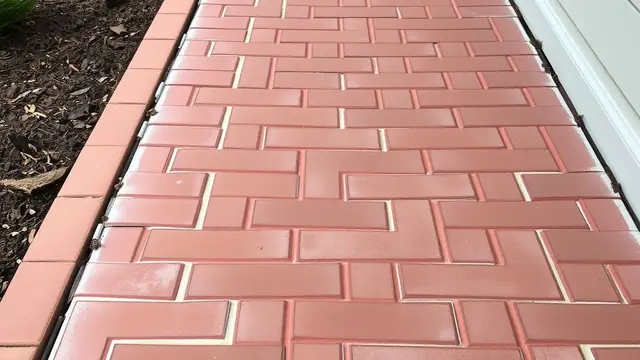
Efflorescence is a crystalline salt deposit on the surface of masonry. The salt comes from the paver itself, the bedding sand, the base gravel, or the subgrade. That is why a patio built on a base with a high soluble salt content can bloom even when the surface looks perfectly drained.
Water is the transport. It dissolves the salt, moves through the material by capillary action, and evaporates at the surface, leaving the salt behind.
That is why the bloom appears in bands, at joints, and on the shaded or damp side of a patio. It marks where water is moving and evaporating. The pattern is a map of the moisture path, which is why photographing it before cleaning is useful.
Why water is the whole story
| Water source | How it reaches the surface | Fix |
|---|---|---|
| Rain soaking the pavers | Capillary rise and evaporation | Breathable sealer, slope |
| Water under the base | Wicking up through bedding | Drainage, geotextile |
| Downspout discharge | Concentrated flow at one edge | Extend the downspout |
| Poor slope | Water sits and soaks in | Regrade the surface |
| New pavers | Manufacturing moisture | Time and dry weather |
The last row matters for new installations. Fresh pavers and fresh bedding can bloom for a few weeks as they dry, and that is normal. Bloom that persists or returns after rain is a moisture problem. So is bloom that appears only in one band while the rest of the patio stays clean.
Removal, step by step
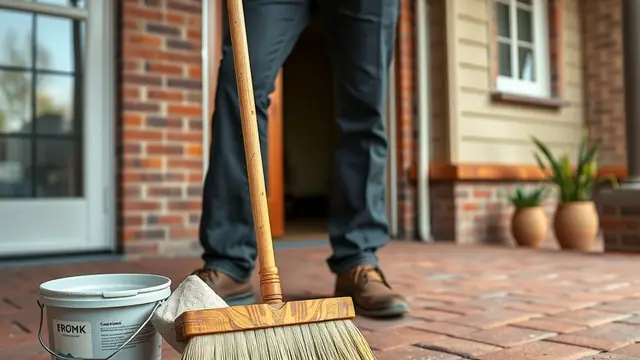
- Brush the dry bloom with a stiff brush and sweep it up. Do not wet it first.
- If a residue remains, wash with a mild acid cleaner diluted per the label, working in small sections.
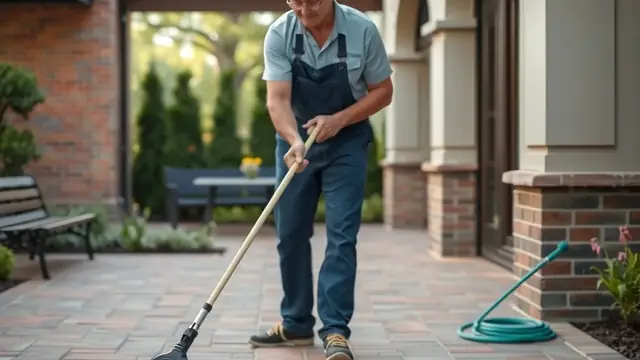
- Scrub with a soft brush, then rinse thoroughly with clean water.
- For stubborn patches, apply a poultice and cover it to draw the salt out.
- Let the surface dry completely and check after a week.
- Repeat only if new bloom appears, and investigate the water source before sealing.
The rinse is critical. Acid left on the surface continues to react and can etch the paver or damage the joint sand. A second rinse with a neutralizing solution, followed by clean water, is cheap insurance on a large patio.
What not to do
Do not pressure wash at high pressure. It drives water deeper into the pavers and joints, which draws more salt to the surface later.
Do not seal over an active bloom. The sealer traps the salt under the film and produces a white haze that is harder to remove than the original deposit.
Do not use a strong acid on clay brick without testing. Clay is more sensitive than concrete, and a strong acid can dissolve the surface.
Do not assume one treatment is enough. Efflorescence often needs two or three cycles, spaced by dry weather. Each cycle draws a little more salt out, and the bloom gets fainter until it stops.
Sealing and breathability
A breathable sealer slows water absorption without trapping vapor. That reduces the water available to dissolve salt and makes the surface easier to clean.
A film-forming sealer can trap moisture and cause the bloom to appear under the film, which looks like a milky haze. On a patio with a history of efflorescence, a penetrating sealer is the safer choice. Ask for the product data sheet and check whether it is breathable before it goes on.
Sealing at $1 to $3 per square foot is the cost line. On a 200 square foot patio at $2, that is 200 × $2 = $400.
When it signals a bigger problem
Efflorescence that returns in the same band after every rain is a drainage symptom. The water is coming from somewhere specific: a downspout, a slope toward the house, or a base that stays saturated.
In that case, cleaning is cosmetic. The durable fix is to correct the drainage, which may mean regrading, extending a downspout, or repairing the base at $4 to $8 per square foot.
On clay brick, repeated bloom can lead to surface scaling, where the face of the brick flakes away. That is a material failure, and it is worth catching before the pavers need replacing. Scaling is also the point at which cleaning stops being a maintenance task and becomes a replacement decision.
What the repair costs
A DIY treatment is a stiff brush, a mild acid cleaner and a hose. Material cost is modest, and the labor is a dry afternoon. The risk is in the rinse: a weak rinse leaves acid in the joints, and the bloom returns with company.
A professional cleaning is priced per square foot and includes the wash and rinse. Sealing afterward is $1 to $3 per square foot.
A base repair, if the moisture source is under the patio, is $4 to $8 per square foot. On 200 square feet at $6, that is $1,200 before resealing.
For the prevention routine, see efflorescence prevention. For the early signs, read efflorescence warning signs, and for the cost detail, check the efflorescence cost guide.
Frequently asked questions
What causes white powder on pavers?
Efflorescence: soluble salts carried to the surface by water and left behind when the water evaporates. The salt comes from the paver, the bedding sand, or the base.
Will washing remove efflorescence?
Water alone can make it worse by dissolving more salt and drawing it to the surface. Brush dry first, then use a mild acid wash or a poultice and rinse thoroughly.
Does sealing stop efflorescence?
A breathable sealer slows water absorption and can reduce it, but sealing over active efflorescence traps salt and causes a haze. Remove the bloom and fix the moisture first.
Why does efflorescence keep coming back?
Because the water source is still active. A failed slope, a blocked outlet, or water wicking from the subgrade will keep carrying salt to the surface.
Is efflorescence harmful to the pavers?
It is mostly cosmetic, but repeated cycles can cause surface scaling and spalling, especially on clay brick. Persistent bloom is a sign of a moisture problem worth fixing.
When can I seal after treatment?
Wait until the pavers are dry and no new bloom appears for at least a week. Sealing a damp or still-active surface traps the salt under the film.
Sources
Some links are affiliate links.If you buy through them we may earn a commission at no extra cost to you. We do not accept payment for rankings. Read the full disclosure.