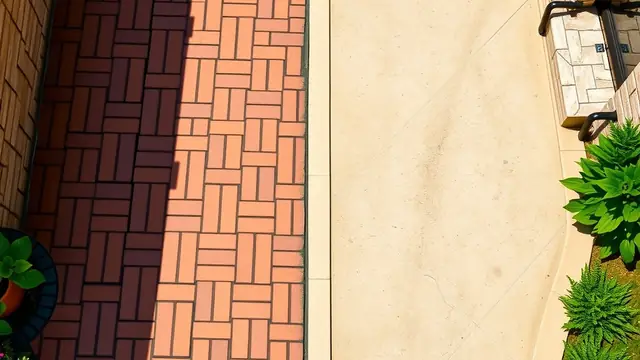
Concrete pavers vs Travertine
Concrete pavers and travertine compared on cost, heat, slip resistance and maintenance, including the sealing travertine usually needs.
Concrete pavers cost $8 to $15 per square foot and travertine $15 to $30. Travertine stays cooler underfoot and suits pool decks, but it is heavier, more expensive, and needs sealing to resist staining and efflorescence.
- Concrete pavers
- $8 - $15 per square foot
- Travertine
- $15 - $30 per square foot
- Sealing
- $1 - $3 per square foot
- Base repair
- $4 - $8 per square foot
Some links on this page are affiliate links.If you buy through them we may earn a commission at no extra cost to you. We do not accept payment for rankings. Read the full disclosure.
Concrete pavers and travertine both work as patio and pool-deck surfaces, but they sit at different price points: $8 to $15 per square foot for concrete, $15 to $30 for travertine. Travertine stays cooler, looks more natural, and needs sealing. Concrete is cheaper, lighter and easier to replace.
What each material is
Concrete pavers are manufactured units with a cement-based body and a pigment layer. They are uniform, consistent in size, and available in a wide range of colors and textures.
Travertine is a natural limestone formed by mineral springs. It has a fibrous, banded structure with natural voids, and it is cut into pavers in honed, tumbled or polished finishes. The voids are part of the character, and some grades are filled at the factory with a cement or resin filler.
Both are laid on a compacted base with a sand bedding. Travertine is heavier per square foot, which affects handling and the base specification.
Side by side
| Trait | Concrete pavers | Travertine |
|---|---|---|
| Cost | $8 - $15 / sq ft | $15 - $30 / sq ft |
| Heat underfoot | Warmer | Cooler |
| Weight | Moderate | Heavy |
| Surface | Uniform | Natural, banded |
| Slip resistance | Good with texture | Good if honed or tumbled |
| Sealing | Optional | Usually required |
| Stain resistance | Moderate | Lower without sealer |
| Repair match | Easy with same batch | Hard after the lot changes |
The sealing row is the one homeowners underestimate. Travertine is porous, and an unsealed travertine patio absorbs oil, wine and leaf tannins. Once absorbed, those stains are difficult to draw out without a poultice.
The arithmetic on 200 square feet
Concrete pavers at $11 per square foot: 200 × $11 = $2,200.
Travertine at $22 per square foot: 200 × $22 = $4,400.
Base repair at $6 per square foot applies to both: 200 × $6 = $1,200.
Sealing at $2 per square foot: 200 × $2 = $400.
The material difference is $2,200 on this patio, and the base and sealing are identical. That is the number to weigh against the appearance and the cooler surface. On a 400 square foot pool deck, the same comparison is $4,400.
Where travertine wins
Heat is the main advantage. Travertine stays noticeably cooler than concrete in direct sun, which is why it is the default around pools and on patios used barefoot. The lighter colors reflect more solar gain, and the stone’s structure releases heat more slowly.
Appearance is the second. The natural banding and color variation cannot be reproduced in a manufactured paver, and the surface develops a soft patina.
Water behavior is the third. A honed travertine deck sheds water well and does not show water spots as readily as a dark concrete paver. Around a pool, that difference is visible every day the deck is wet.
Where concrete pavers win
Cost is the obvious advantage, and it matters most on a large patio or a driveway. On 400 square feet, the gap between $11 concrete and $22 travertine is $4,400, which is a landscape budget on its own.
Durability in freeze-thaw is the second. Concrete pavers are manufactured to a consistent standard and are generally air-entrained; travertine varies by source and some types are more frost-sensitive. In a cold climate, ask for the absorption rate before committing to stone.
Repair is the third. A cracked concrete paver is replaced with a matching unit. A cracked travertine paver may not match the rest of the field, because natural stone varies from lot to lot and even within a pallet.
Maintenance differences
Concrete pavers need joint sand, occasional weeding and optional sealing. Stains sit on the surface and clean up with a degreaser. A concrete patio that is cleaned twice a year and re-sanded every few years will hold its appearance for a long time.
Travertine needs sealing to resist staining, and it needs a pH-neutral cleaner because acid etches limestone. Efflorescence is common and is treated with a dry brush and a mild wash. Resealing every two to three years is typical, which is more frequent than concrete requires.
Both need the same joint maintenance. Wide travertine joints take more sand and collect more organic matter, and they are the first place weeds appear on either surface.
Slip resistance and pool safety
A honed or tumbled travertine has good grip when wet and is the usual choice around a pool. A polished travertine is slippery and should not be used on a wet deck. The finish is chosen at the quarry, so it has to be specified before the order is placed.
Concrete pavers with a textured face also perform well when wet, and a flamed or shot-blast finish is the pool-deck option.
Neither material replaces proper drainage. A slippery surface with standing water is a hazard regardless of the material. A pool deck needs a slope away from the coping and a drain or a deck drain at the low edge.
Choosing between them
- Decide whether heat underfoot matters, which usually means a pool or barefoot use.
- Set the budget with base and sealing included.
- Confirm the travertine grade is suitable for freeze-thaw if you are in a cold climate.
- Choose a honed or tumbled finish for wet areas.
- Price sealing for both materials.
- Ask about replacement availability for the specific product.
For the travertine cost detail, see travertine pavers cost. For the concrete side, read concrete pavers cost, and for the base both need, check paver base preparation.
Frequently asked questions
Is travertine worth the extra cost over concrete pavers?
It is worth it for a pool deck or a high-end patio where heat and appearance matter. For a utility patio, concrete pavers at half the price perform well.
Does travertine get hot in the sun?
Less than concrete. Travertine's lighter colors and natural porosity keep the surface cooler underfoot, which is why it is common around pools.
Does travertine need sealing?
Yes for most installations. Travertine is porous, and sealing at $1 to $3 per square foot helps resist staining, efflorescence and freeze-thaw damage.
Is travertine slippery when wet?
A honed or tumbled finish has good grip. A polished finish is slippery and should not be used around a pool.
How much does a travertine patio cost?
Travertine runs $15 to $30 per square foot. A 200 square foot patio at $22 is 200 × $22 = $4,400 before base repair and sealing.
Can travertine be laid on a standard paver base?
Yes, on a properly compacted base. Travertine is heavier than concrete, so the base needs to be well compacted and the thickness suited to the load.
Sources
Some links are affiliate links.If you buy through them we may earn a commission at no extra cost to you. We do not accept payment for rankings. Read the full disclosure.