Concrete pavers vs Flagstone
Concrete pavers and flagstone compared for patios: cost per square foot, installation speed, repair and how each handles an uneven base.
Concrete pavers cost $8 to $15 per square foot and lay quickly in uniform units; flagstone is natural stone sold by the ton and fitted piece by piece, which usually costs more. Both need 4 inches of compacted base and a draining slope.
- Concrete pavers
- $8 - $15 per square foot
- Flagstone
- Priced by the ton
- Base repair
- $4 - $8 per square foot
- Sealing
- $1 - $3 per square foot
Some links on this page are affiliate links.If you buy through them we may earn a commission at no extra cost to you. We do not accept payment for rankings. Read the full disclosure.
Concrete pavers and flagstone both make durable patios on a compacted base, but they are built differently. Pavers are uniform units laid in a pattern at $8 to $15 per square foot; flagstone is natural stone sold by the ton and fitted piece by piece, which usually costs more and takes longer.
What each material is
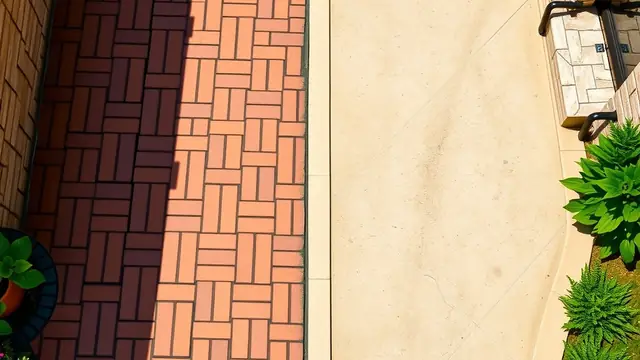
Concrete pavers are manufactured to consistent dimensions with chamfered edges and interlocking profiles. The field goes down quickly, and the pattern repeats. Because the units are identical, a paved field has a regular rhythm that reads as deliberate rather than accidental.
Flagstone is natural stone, split or sawn to thickness. Pieces are irregular in shape and size, and each one is fitted to its neighbors with a saw, a chisel or a hammer. The result is a surface with no repeating unit and a color range that comes from the stone itself.
Both are dry-laid on a sand bedding over compacted gravel. The base specification is the same, and so is the failure mode when the base is wrong.
Side by side
| Trait | Concrete pavers | Flagstone |
|---|---|---|
| Cost | $8 - $15 / sq ft | Priced by the ton |
| Unit consistency | High | Low |
| Install speed | Fast | Slow |
| Cutting | Saw at edges | Saw and chisel throughout |
| Pattern | Repeats | One-of-a-kind |
| Repair match | Easy | Difficult |
| Surface | Uniform | Natural variation |
| Base requirement | 4 inches compacted | 4 inches compacted |
The install-speed row drives much of the price difference. Flagstone labor is per piece, not per square foot, and a patio with many small stones takes longer than one with large slabs. A flagstone patio made of big, uniform slabs is a different job from one made of small, irregular pieces.
The arithmetic on 200 square feet
Concrete pavers at $11 per square foot: 200 × $11 = $2,200.
Flagstone is priced by the ton. Coverage per ton depends on thickness, so the material line varies with the stone selected. Ask for tonnage and expected coverage, then add the fitting labor.
Base work is the same for both: $4 to $8 per square foot for a rebuild. On 200 square feet at $6, that is 200 × $6 = $1,200. That line is the same whether the surface is concrete or stone, which is why the base should be priced first.
Sealing at $2 per square foot: 200 × $2 = $400.
Where concrete pavers win
Cost is the first advantage, and it is predictable. A square-foot price lets you budget before the work starts, and the material is stocked rather than quarried to order. That predictability is worth a lot on a project with a fixed budget.
Speed is the second. A 200 square foot patio is a short job for an experienced crew, and the pattern goes down without fitting. That speed also means the patio is usable sooner and the yard is torn up for less time.
Repair is the third. A damaged paver is lifted and replaced with an identical unit, and the repair disappears into the field.
Where flagstone wins
Appearance is the main reason. No two stones are alike, the surface has natural variation, and the patio reads as stone rather than as a manufactured product.
Thermal behavior is the second. Stone stays cooler underfoot than concrete in direct sun, which matters on a patio used barefoot.
Aging is the third. Flagstone develops a patina and looks better with time, while concrete pavers can fade or look dated after a decade. That is a matter of taste, but it is the reason many homeowners choose stone for a patio they intend to keep.
Cutting, fitting and waste
Concrete pavers are cut at the edges and around obstacles. The field is laid whole, so waste is low, typically 5 to 10 percent.
Flagstone is cut throughout, because every piece has to fit its neighbors. Waste is higher, and breakage during handling adds to it. Ordering 10 to 15 percent extra is normal.
That waste is part of the cost difference, and it is why a flagstone quote can vary so much between contractors. A crew that cuts carefully and uses offcuts in the field wastes less than one that cuts every piece to fit and discards the rest.
Which handles an uneven base better
Both fail on a bad base, but they fail differently.
A concrete paver field that settles shows a dip and open joints, and the pattern makes the movement obvious.
A flagstone patio that settles shows individual rocking stones, which can be reset one at a time. That repairability is an advantage on a site with tree roots or a subgrade that moves. A paver field can also be lifted and relaid, but the interlock has to be rebuilt across the whole area.
Neither material compensates for a base that was not compacted. The base repair rate applies to both.
Choosing between them
- Set the budget for the finished patio, including base and sealing.
- Decide how much irregularity you want in the pattern.
- Confirm the base depth and the slope for your site.
- Ask for flagstone tonnage and coverage in writing.
- Order 10 to 15 percent extra for flagstone, 5 to 10 percent for pavers.
- Price sealing at $1 to $3 per square foot for either.
For the flagstone method, read flagstone installation. For the paver side, see concrete pavers cost, and for the base both need, check paver base preparation.
Frequently asked questions
Is flagstone cheaper than concrete pavers?
Rarely. Concrete pavers run $8 to $15 per square foot installed, while flagstone is sold by the ton and fitted by hand, which usually costs more for the same area.
Which is faster to install?
Concrete pavers. Uniform sizes and interlocking edges make layout fast, while flagstone requires cutting and fitting each irregular piece.
Can flagstone be laid on the same base as pavers?
Yes. Both use a compacted gravel base, about 4 inches for a patio, with a 1 inch sand bedding layer and a 2 percent slope.
Which is easier to repair?
Concrete pavers, because a damaged unit is replaced with an identical one. Flagstone can be reset, but matching the stone after the lot changes is difficult.
Does flagstone need more maintenance?
It needs similar joint care plus occasional stone-specific cleaning for iron and organic stains. Concrete pavers are more uniform and easier to clean.
Which looks more natural?
Flagstone, because it is natural stone with irregular shapes and color variation. Concrete pavers are manufactured and repeat their pattern.
Sources
Some links are affiliate links.If you buy through them we may earn a commission at no extra cost to you. We do not accept payment for rankings. Read the full disclosure.