Settling: warning signs
Early signs of paver settling: dips underfoot, water pooling, joints opening, rocking units and spread edges, and what each one points to.
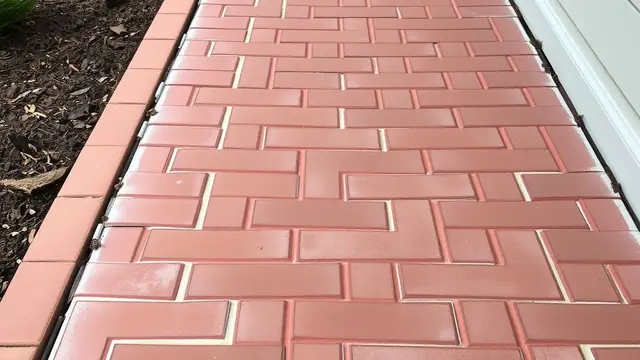
Settling shows first as a shallow dip you feel underfoot, then as water pooling in the same spot after rain. Joints open around the dip, pavers begin to rock, and the edge may spread as the base loses support.
- First sign
- A dip felt underfoot
- Second sign
- Water pooling after rain
- Third sign
- Joints opening around the dip
- Late sign
- Pavers rocking or cracking
Some links on this page are affiliate links.If you buy through them we may earn a commission at no extra cost to you. We do not accept payment for rankings. Read the full disclosure.
Settling announces itself as a dip you feel before you see it. Walk the patio and a low spot shows up as a slight drop underfoot; after rain, the same spot holds a puddle. By the time joints open around the dip and pavers begin to rock, the base has already lost support.
The dip underfoot
The first sign is physical rather than visual. A shallow depression changes your gait by a fraction of an inch, and it is easiest to find by walking the patio slowly in bare feet or thin shoes.
A straightedge laid across the suspect area shows the depth. Anything over a quarter inch is worth marking, and anything over half an inch needs a base assessment.
The dip also changes with the season. A patio that is flat in summer can show a dip after a wet winter, because the base is holding water and the subgrade has softened. If the dip appears and disappears, the base is draining poorly rather than having failed outright.
Photograph the straightedge with a ruler against it. That gives you a record to compare against in six months.
Water pooling in the same place
Water is the most reliable indicator. A patio that drained evenly last year and ponds this year has changed shape.
The puddle marks the lowest point, which is where the base has consolidated or the bedding has washed out. It is also where the next round of erosion will happen, because standing water softens the sand beneath the pavers.
If the puddle sits against the house, treat it as urgent. Water against the foundation is a different problem from water in the middle of a patio. It can find the basement wall, soften the soil under a step, and stain the siding at the splash line.
The signs in order
| Sign | What it means | Stage |
|---|---|---|
| Dip felt underfoot | Bedding has shifted | Early |
| Water pooling | Surface slope has changed | Early |
| Joints opening around the dip | Pavers moving apart | Moderate |
| Sand trails at the low edge | Bedding washing out | Moderate |
| Rocking pavers | Void under the unit | Late |
| Cracked pavers | Point load over a void | Late |
| Spreading edge | Restraint has failed | Late |
The early signs are cheap to fix. The late ones need base repair at $4 to $8 per square foot.
Joints opening and sand trails
As the base settles, the pavers move apart and the joints widen. Sand appears on the surface or in a line at the low edge after rain.
That sand came from the bedding layer. Every storm takes more of it, and the void under the pavers grows.
Widened joints also let more water in, which accelerates the process. The cycle is self-reinforcing once it starts. Widened joints let in more water, the water moves more sand, the void grows, and the next storm takes more fill. That is why a joint that was a half inch deep in spring can be an inch deep by autumn.
Rocking and cracking
A rocking paver is one that pivots when stepped on. It means the unit is spanning a void rather than sitting on a full bed.
Rocking is the point at which the repair cost rises. The paver can still be lifted and re-bedded, but the base beneath it needs attention or the rock returns.
Cracking follows. A paver that spans a void takes a bending load it was not designed for, and thin units crack first. Once a paver cracks, water enters the break and the base beneath it softens faster, so a single cracked unit is a warning about the area around it.
Thresholds, edges and transitions
Check where the patio meets the house, a step, or a driveway. Those transitions show settlement early because the fixed element does not move while the patio does.
A step that has become a trip hazard, a door that now clears the pavers by less than it used to, and a driveway apron that has dropped are all signs of movement at the edge.
The outer course is the other place to look. If it has spread outward, the restraint has failed and the joints behind it will open.
The inspection routine
- Walk the patio slowly and mark any dip you feel.
- Lay a straightedge across each mark and measure the gap.
- Look for puddles after rain and note where they sit.
- Check the joints around the low area for widening and sand loss.
- Step on each paver and listen for a hollow sound.
- Check the edges and transitions for spreading or drop.
That routine takes fifteen minutes and separates a cosmetic dip from a base failure.
What each stage costs to fix
An early dip with sound pavers is a local re-bed: a few hours and a bag of sand.
A moderate dip with open joints needs a local base repair and re-sanding, which is priced within the $4 to $8 per square foot base range for the affected area.
A late-stage failure with rocking pavers across a large area is a full base repair. On 200 square feet at $6, that is 200 × $6 = $1,200, plus sealing at $1 to $3 per square foot.
For the repair method, read settling repair options. For prevention, see settling prevention, and for the cost detail, check the settling cost guide.
Frequently asked questions
How do I know if my pavers are settling?
A dip you feel when walking, water that pools in one spot, and joints that have opened around the low area. A straightedge laid across the surface shows the depth.
Is a small dip a problem?
It is an early warning. A dip that holds water will keep eroding the bedding, and the repair is cheaper before the pavers start to rock.
Why does water pool on a patio that used to drain?
The surface has settled and changed the slope, or the outlet is blocked. Either way, the low spot is where the base is losing support.
Can settling cause a tripping hazard?
Yes. A lip of a quarter inch or more between adjacent pavers catches a toe. That is the point at which a repair becomes a safety issue as well as a cosmetic one.
What does a hollow sound mean?
That the paver is no longer sitting on a full bed. A void has formed beneath it, usually because water has moved the bedding sand.
When should I call a contractor?
When several pavers rock, when a dip is deeper than about half an inch, or when water pools against the house. Those need a base assessment rather than a top-up.
Sources
Some links are affiliate links.If you buy through them we may earn a commission at no extra cost to you. We do not accept payment for rankings. Read the full disclosure.