Rutting under cars: warning signs
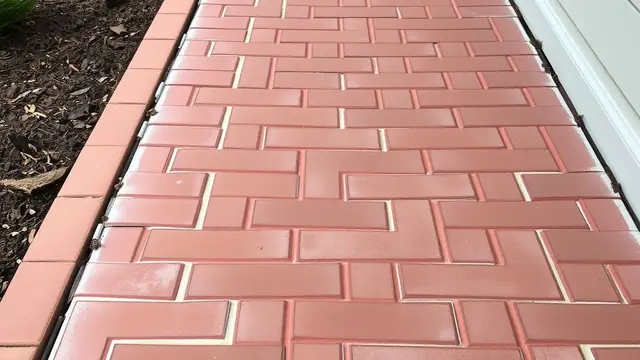
Early signs of wheel-path rutting in a paver driveway: shallow depressions, water in the ruts, open joints and polished paver faces.
Rutting starts as a shallow depression in the wheel path that you feel when walking or see as water standing after rain. Open joints along the rut, polished paver faces and a hollow sound underfoot follow as the base loses support.
- First sign
- Shallow wheel-path depression
- Second sign
- Water standing in the rut
- Third sign
- Joints opening along the path
- Late sign
- Rocking or cracked pavers
Some links on this page are affiliate links.If you buy through them we may earn a commission at no extra cost to you. We do not accept payment for rankings. Read the full disclosure.
Rutting under cars begins as a shallow depression in the wheel path, usually felt before it is seen. A straightedge laid across the path shows the depth, and water standing in the same two strips after rain confirms it. By the time joints open along the rut, the base has already lost support.
The straightedge test
Lay a 4 foot level or straightedge across the wheel path, perpendicular to the direction of travel. Measure the gap at the lowest point with a tape or a feeler gauge.
A quarter inch is worth recording. Half an inch is a repair. An inch is a base failure that has probably been developing for more than a year. Write the measurements down with the date, because rutting is a slow process and the trend matters more than a single reading.
Do the test in both wheel paths and at two points along the driveway, because the ruts do not always develop evenly.
Water in the ruts
The second sign is standing water in the depressions after rain. It is easy to dismiss as a slope issue, but on a driveway it usually means the surface has settled.
Standing water is also the accelerant. It softens the base under the rut, which lets the rut deepen, which holds more water. The cycle is self-reinforcing. In freezing weather, the same water expands and lifts the pavers at the rut edges, so the damage is not limited to the wet season.
Photograph the puddles after a storm and measure the length of the wet strip. That gives you a baseline to compare with next season.
The signs in order
| Sign | What it means | Stage |
|---|---|---|
| Shallow depression | Base consolidating | Early |
| Water standing in the path | Surface has settled | Early |
| Joints opening along the rut | Pavers moving apart | Moderate |
| Sand at the edges of the rut | Bedding washing out | Moderate |
| Hollow sound underfoot | Void beneath the paver | Late |
| Rocking pavers | Base has failed locally | Late |
| Cracked pavers | Point load over a void | Late |
The early signs are cheap to address. The late ones need base repair at $4 to $8 per square foot.
Polished faces and wear patterns
Tire scrub polishes the paver surface in the wheel paths. The faces look smoother and slightly lighter than the surrounding field.
Polishing is not rutting, but the two develop together because the same area takes the load. If the polish appears and the surface is still flat, the base is holding. If the polish appears with a depression, the base is moving. Comparing the two wheel paths also helps: one polished and flat, the other polished and sunk, points to a base problem on one side.
Scuffing at the driveway apron is normal on a turn. It becomes a problem when it is accompanied by spreading pavers or open joints.
Joints opening along the rut
As the base consolidates, the pavers move apart. The joints along the wheel path widen, and sand appears on the surface.
Widened joints let water in, which softens the base further. That is why the joint width is a better early indicator than the rut depth on a driveway that sees daily use. A joint that has gone from tight to a quarter inch in a season is telling you the base is moving.
Check the joints at the edge of the rut first. Spreading starts at the perimeter and works inward. On a driveway with a single wheel path more worn than the other, the difference usually reflects how the car is parked rather than a problem with the pavers.
Rocking and cracking
A rocking paver pivots underfoot. It means the unit is bridging a void, and the base beneath it needs to be rebuilt rather than topped up. The rocking is often more noticeable in cold weather, when the paver and the base contract at different rates.
Cracking follows, especially on thin pavers or on a driveway with heavy vehicles. A cracked paver in a wheel path is a signal that the base has failed locally.
At that point the repair is excavation, not re-bedding. The base repair rate applies, and broken units are replaced.
What the signs mean for cost
A shallow depression with sound pavers can be re-bedded locally for a few hundred dollars.
A rut with open joints and a hollow sound needs a local base rebuild, priced at $4 to $8 per square foot for the affected area. That is the point at which a top-up stops being an option, because the base has to be reworked rather than topped.
A full driveway rebuild on 400 square feet at $6 per square foot is 400 × $6 = $2,400 before sealing and replacement pavers. Sealing at $1 to $3 per square foot adds $400 to $1,200. Replacement pavers, if a tenth of the field breaks during lifting, add the material cost for 40 square feet.
The inspection routine
- Walk the driveway and note any dip you feel.
- Lay a straightedge across each wheel path and measure.
- Check for standing water after rain.
- Inspect the joints along the rut for widening.
- Tap each paver in the rut and listen for a hollow sound.
- Check the edges for spreading and the apron for movement.
For the repair method, read rutting under cars repair options. For prevention, see rutting under cars prevention, and for the cost detail, check the rutting repair cost guide.
Frequently asked questions
How do I know if my paver driveway is rutting?
Lay a straightedge across the wheel path and measure the gap. A depression of a quarter inch or more, especially one that holds water, is rutting rather than normal wear.
Why does water stand in the wheel path?
The surface has settled and created a low spot, or the base has consolidated under the tire loads. Standing water accelerates the failure by softening the base.
Are polished paver faces a sign of rutting?
They are a sign of traffic wear. Polishing appears where tires scrub, and it often develops alongside a depression because the same area takes the load.
What does a hollow sound mean?
The paver is no longer sitting on a full bed. A void has formed, usually because the base has consolidated or the bedding has migrated.
Can rutting be reversed without lifting the pavers?
No. The base has to be corrected, which means lifting the pavers in the affected area and rebuilding the base beneath them.
When is rutting a safety issue?
When the depression holds water that freezes, or when adjacent pavers form a lip that catches a foot or a tire. Both are trip and slip hazards.
Sources
Some links are affiliate links.If you buy through them we may earn a commission at no extra cost to you. We do not accept payment for rankings. Read the full disclosure.