Paver Driveway Cost: Sizes, Base Depth, and Real Budgets
Paver driveway costs by size and material, why driveways price above patios, deeper base math, removal allowances, and a full budget walkthrough.
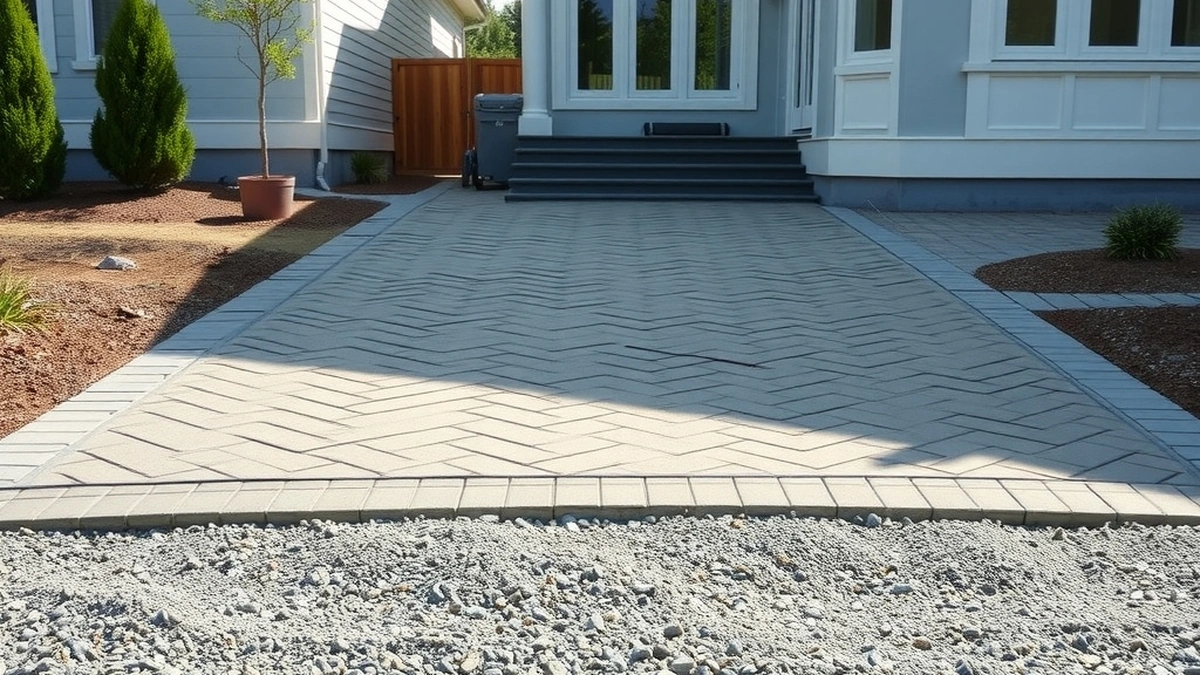
A paver driveway typically costs $3,700 to $12,500, using concrete pavers at roughly $12 to $15 per square foot because driveways need a deeper base and thicker units than patios.
- 288 sq ft single drive
- $3,500–$4,300
- 480 sq ft double drive
- $5,800–$7,200
- Driveway base depth
- 8–12 in compacted
- Old surface removal
- $1,500–$3,500 allowance
Some links on this page are affiliate links.If you buy through them we may earn a commission at no extra cost to you. We do not accept payment for rankings. Read the full disclosure.
A paver driveway typically costs $3,700 to $12,500 depending on size, and the installed rate lands at the top of the paver band — roughly $12 to $15 per square foot for concrete pavers. The premium is not decorative. A driveway carries vehicle loads, so it needs a base two to three times deeper than a patio and thicker units above it.
Why Driveways Cost More Than Patios
A paver driveway is a vehicle-rated segmental pavement: 80 mm units, an 8-to-12-inch compacted aggregate base, heavy-duty edge restraint, and transitions at the apron and garage. Every one of those differences costs money.
The base is the big one. Doubling the base depth doubles the aggregate volume, the truckloads, the compaction passes, and the spoil that has to leave the site. On a patio, 6 inches of base is standard. On a driveway, 8 inches is the practical minimum and 12 is common over clay or where a heavy truck parks.
Cost per Square Foot
Because the facts for paver materials are stated as installed ranges, a driveway simply prices at the upper end of those ranges rather than outside them.
| Material | Driveway rate | 480 sq ft total |
|---|---|---|
| Concrete pavers, 80 mm | $12–$15 | $5,760–$7,200 |
| Brick pavers, 80 mm | $16–$20 | $7,680–$9,600 |
| Permeable pavers | $20–$25 | $9,600–$12,000 |
| Travertine pavers | not recommended | — |
Travertine is a patio and pool-deck stone. It is too soft and too porous for vehicle traffic, and no reasonable base makes it a driveway material.
The arithmetic for concrete pavers: 480 × $12 = $5,760, and 480 × $15 = $7,200. Brick at 480 × $16 = $7,680 to 480 × $20 = $9,600. Permeable at 480 × $20 = $9,600 to 480 × $25 = $12,000.
Cost by Driveway Size
| Size | Square feet | Concrete pavers at $13.50 |
|---|---|---|
| 12 × 24 single | 288 | $3,888 |
| 16 × 24 | 384 | $5,184 |
| 20 × 24 double | 480 | $6,480 |
| 24 × 40 | 960 | $12,960 |
The figures use the midpoint of the $12 to $15 band, so they are planning numbers rather than quotes. A single-car driveway under 300 square feet often carries a mobilization premium that pushes the effective rate higher, while a 960-square-foot driveway usually prices at the lower end because fixed costs spread across more area.
Base Depth in Tons
The volume of aggregate is what separates a driveway budget from a patio budget. For a 480-square-foot driveway with a 9-inch base: 480 × 0.75 ft = 360 cubic feet, and 360 ÷ 27 = 13.3 cubic yards.
At roughly 2,700 pounds per cubic yard, that is about 36,000 pounds — eighteen tons of base material that has to be delivered, spread in lifts, and compacted before a single paver is laid. A 400-square-foot patio with a 6-inch base uses about 7.4 cubic yards, so the driveway is nearly twice the aggregate for 20 percent more area.
Removal and Site Work
Most driveway projects start by removing something. Asphalt, old concrete, gravel, or lawn all have to go, and disposal is priced by weight or by the dumpster.
Plan on a removal and disposal allowance of $1,500 to $3,500 for a two-car driveway. Ask whether it is inside the paver quote, because a bid that excludes it looks cheaper until the invoice arrives.
Other site work that shows up on driveway jobs:
- Widening the apron where it meets the street
- A channel drain or trench drain at the garage
- Regrading to keep water off the slab and out of the garage
- Saw-cutting and tying into an existing walkway
- Relocating a downspout or utility box
Slope, Drainage, and Winter
A driveway has to drain, and it has to drain without sending water into the garage or onto a neighbor’s lot. Slope away from the garage is typically about 1/8 inch per foot, and the apron transition at the street is where most ponding complaints originate.
Pavers handle freeze-thaw well because the joints accommodate movement, but they are not immune to poorly drained base. Standing water under a driveway in winter produces heave, and heave on a vehicle surface produces ruts.
Snow plows are the other consideration. A steel blade dragged across pavers can chip edges, especially on a raised border. Plastic-edged blades or a rubber cutting edge protect the surface, and sand is a better deicing choice than rock salt, which attacks joint sand and accelerates surface wear.
Building the Budget
- Measure the driveway in square feet, including the apron and any widening.
- Ask what is under it now — asphalt, concrete, gravel, or soil — and whether removal is included.
- Confirm the base depth in inches and the number of compaction lifts.
- Specify 80 mm units rather than patio thickness, with the brand and model named.
- Get drainage and the garage transition priced as their own lines.
- Add 10 percent contingency for what excavation finds.
Then compare against the driveway pavers cost breakdown by material and pattern, and check concrete pavers cost if you are pricing the most common option. For the base and drainage side, drainage and pooling prevention covers what good site work looks like.
When a Paver Driveway Is the Wrong Buy
Pavers are a poor fit when the driveway is steep enough that vehicles spin, when the budget cannot cover a proper 8-inch base, or when the only goal is the lowest first cost. Asphalt is cheaper up front and concrete is cheaper to place, even though both are more expensive to repair.
Pavers make sense when you want the driveway to match the walkway and patio, when you plan to stay long enough to amortize the cost, and when you value being able to lift and replace a damaged section instead of patching a slab. For a 480-square-foot driveway, that decision is roughly $6,500 against maybe half that for asphalt — a real premium that has to be worth it to you.
Frequently asked questions
How much does a paver driveway cost for a two-car driveway?
A 20-by-24-foot driveway is 480 square feet. At $12 to $15 per square foot in concrete pavers that is $5,760 to $7,200, before removal of an old surface, drainage work, and any apron detail.
Why is a paver driveway more per square foot than a patio?
The base has to carry vehicles, so it is typically 8 to 12 inches of compacted aggregate instead of 4 to 6. Units are thicker, edge restraint is heavier, and excavation volume roughly doubles.
Can I use patio pavers on a driveway?
No. Patio units are usually 60 mm thick and rated for foot traffic. Driveways need 80 mm units, or thicker where loads are heavy, plus a base designed for vehicle weight.
How much does it cost to remove an old asphalt driveway?
Removal and disposal is commonly quoted as an allowance of $1,500 to $3,500 for a two-car driveway, depending on thickness, haul distance, and dump fees. Confirm whether it is inside or outside the paver quote.
Does a permeable paver driveway cost more?
Yes. Permeable pavers run $12 to $25 per square foot, and a driveway installs at the upper end because the open-graded base is deeper and requires geotextile and careful compaction.
How long does a paver driveway last?
Twenty-five to 30 years is realistic when the base is deep enough and drainage is correct. The common early failures are rutting from an undersized base and edge spread from missing restraint.
Sources
Some links are affiliate links.If you buy through them we may earn a commission at no extra cost to you. We do not accept payment for rankings. Read the full disclosure.